The Venice Biennial: On Black Seas, Dead Waters, and Ghostly Archives
Art projects built on shock and sexuality, such as those presented by Austria or Denmark, have generated extraordinary buzz in the coverage of the 61st Venice Biennial. These projects do not, in my view, fully engage with what Koyo Kouoh, the late Cameroonian curator trained in Switzerland and known for her decolonial approach, defines as the “minor key.” Rather, a posthumanist perspective that rethinks human and nonhuman relations beyond anthropocentric and Eurocentric frameworks lies closest to Kouoh’s curatorial program, which was informed by references to writers Édouard Glissant and Toni Morrison and structured around metaphors such as “the archipelago,” “the right to opacity,” and “relational identity.” In this edition of the Biennial, water, wind, and earth emerge as key motifs, approached through the lens of dwelling and lived experience across both the central exhibition and the national pavilions.
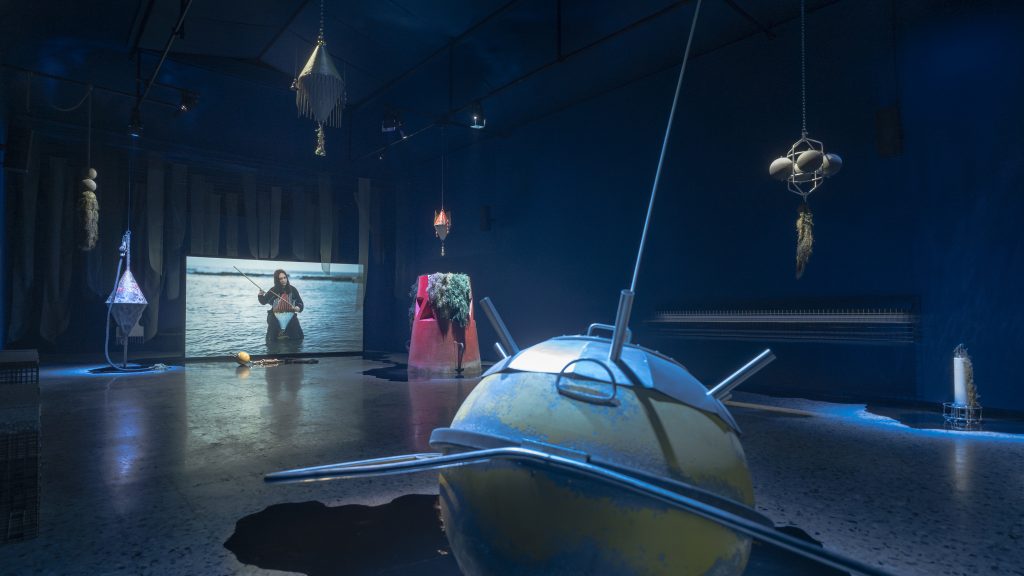
Anca Benera and Arnold Estefán, How to Mend a Broken Sea?, 2026. Photo copyright Samuele Cherubini.
Among the most compelling engagements with these ideas is Romania’s Black Seas: Scores for the Sonic Eye (Blackseas.ro), which constructs a multilayered vision of the Black Sea by intertwining dark elemental poetry, political commentary, and scientific observation through two complementary installations by Anca Benera and Arnold Estefán. One is How to Mend a Broken Sea? (2024-ongoing), a two-channel video installation presented in the Giardini della Biennale alongside buoys and scientific artifacts recovered from the sea. The second is Blue Ground, a three-channel installation shown at the Romanian Institute for Culture and Humanistic Research in Venice, alongside a 3D-printed sculpture inspired by the Tower of Babel, emblematic of human ambition reaching toward the elemental level of the sky.
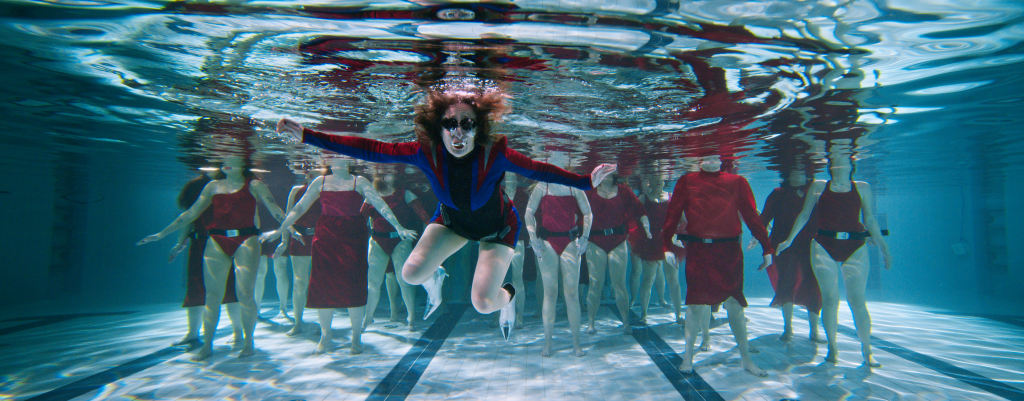
Bogna Burska, Daniel Kotowski, Liquid Tongues, 2026. Video still by Jacopo Salvi (altomare). Courtesy of Zacheta Archive and the Polish Pavilion.
A broader constellation of more-than-human temporalities and forms of perception unfolds throughout the Biennale. Particularly notable is Eglė Budvytytė’s animism sings anarchy for the Lithuanian Pavilion, which engages ancient water rituals from Old Europe. Also notable is the Polish contribution, Liquid Tongues, a video installation by Bogna Burska and Daniel Kotowski, exploring alternative modes of communication inspired by more-than-human life, and the Uzbekistani project The Aural Sea by Jahongir Bobokulov, Zi Kakhramonova, Aygul Sarsen, Zulfiya Spowart, Xin Liu, A.A. Murakami, and Nguyen Phuong Linh, centered on the disappearance of the Aral Sea following Soviet water diversion projects and approached through myth-making and ecological imagination. The Finnish and Hungarian pavilions, Aeolian Suite by Jenna Sutela and Pneuma Cosmic by Endre Koronczi, likewise explore airflow and atmospheric forces as intuitive and relational modes of engaging with the world.
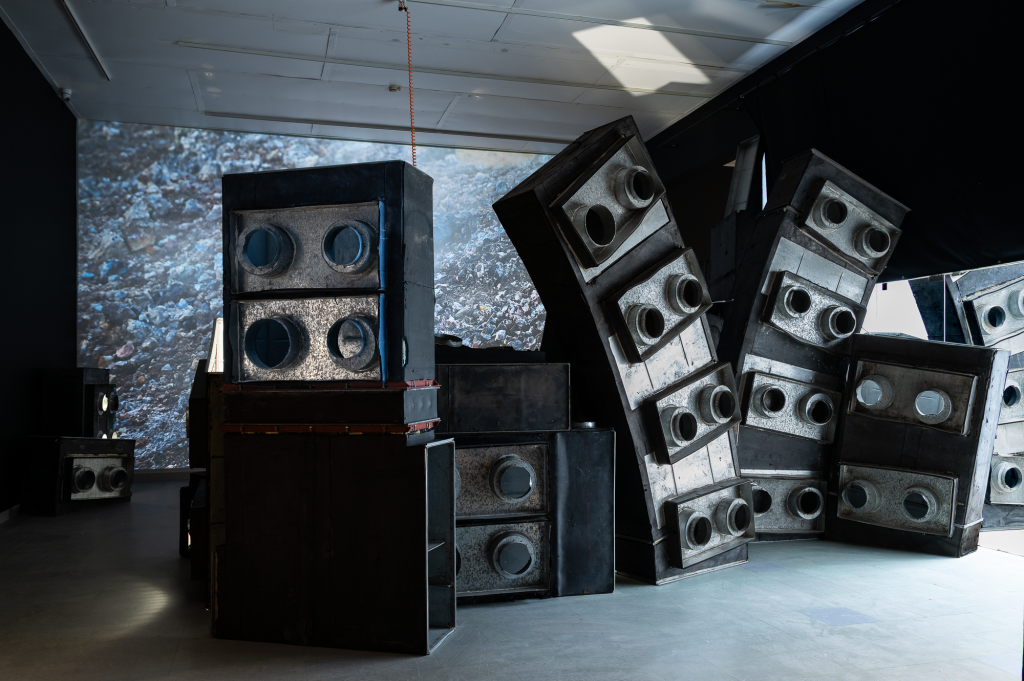
Endre Koronczi, Pneuma Cosmic, 2026, installation view. Copyright Zsófia Szabó and Ludwig Múzeum.
This essay explores how a posthuman perspective, placing natural elements and more-than-human temporalities at the centre, resonates with Kouoh’s curatorial notion of the minor keys, which–starting from their musical association with melancholy, sadness, and strangeness–extends toward a politics and aesthetics of non-dominant registers: forms of listening, sensitivity, and coexistence that oppose spectacular and militarized forms of power, making perceptible worlds, voices, and relations that usually remain at low frequencies. The essay traces this opposition across the pavilions introduced above, bringing into view a constellation of concepts underpinning this framework, including collaboration, the tension between intelligibility and opacity, archival structures, and the reinterpretation of death under late capitalism.
Among these interconnected aspects, collaboration emerges as a particularly visible thread, echoing the collaborative ethos of this Biennial, where Koyo Kouoh’s untimely passing led to her curatorial vision being continued by her team, while also shaping the pavilions themselves through relational forms of working. Within Black Seas: Scores for the Sonic Eye, Anca Benera, Arnold Estefán, and curators Diana Marincu and Corina Oprea bring together musicians and performers such as Laurențiu Coțac, Simina Oprescu, and Diana Miron, whose voice enters into dialogue with the sea, alongside scientists, research institutes, underwater filmmakers, designers, and technicians. The same collaborative logic extends to the pavilions of Lithuania, Uzbekistan, and especially Poland, where the artists worked alongside Chór w Ruchu (“Choir in Motion”), a laboratory in which hearing and Deaf participants explore the relationship between voice, sign, vibration, gesture, and space.
In accordance with the Biennial’s imaginary of the minor keys, collaboration further extends into the territory of the nonhuman. Alongside its powerful video installations, Black Seas includes authentic buoys and floats, as well as a gravity core: a vertical slice of the sea’s geological history preserving compact layers of mud, minerals, and organic remains tens of thousands of years old. While the artists transformed the buoys into musical instruments, they left the gravity core untouched, preserving it as both a material witness to decisive moments, such as the very formation of the Black Sea, and, “in a very concrete sense[, …] a work produced by the Black Sea itself.”(Bogdan Ghiu, “‘Black Seas’: Romania (Anca Benera & Arnold Estefán) at the 2026 Venice Biennale,” Observatorul Cultural, May 8, 2026, https://www.observatorcultural.ro/articol/mari-negre-romania-anca-benera-arnold-estefan-la-bienala-de-la-venetia-2026/.)
Similarly, the Finnish Pavilion Aeolian Suite by Jenna Sutela is created in collaboration with the wind, personified as uncanny figures enveloped in sculptural masses of hair that blur the boundaries between the human, the animal, and the vegetal, while Endre Koronczi in the Hungarian Pavilion Pneuma Cosmic combines an installation incorporating elements of the ventilation system removed from the historic building of the Hungarian Academy of Sciences with poetic video projections devoted to air and breathing.
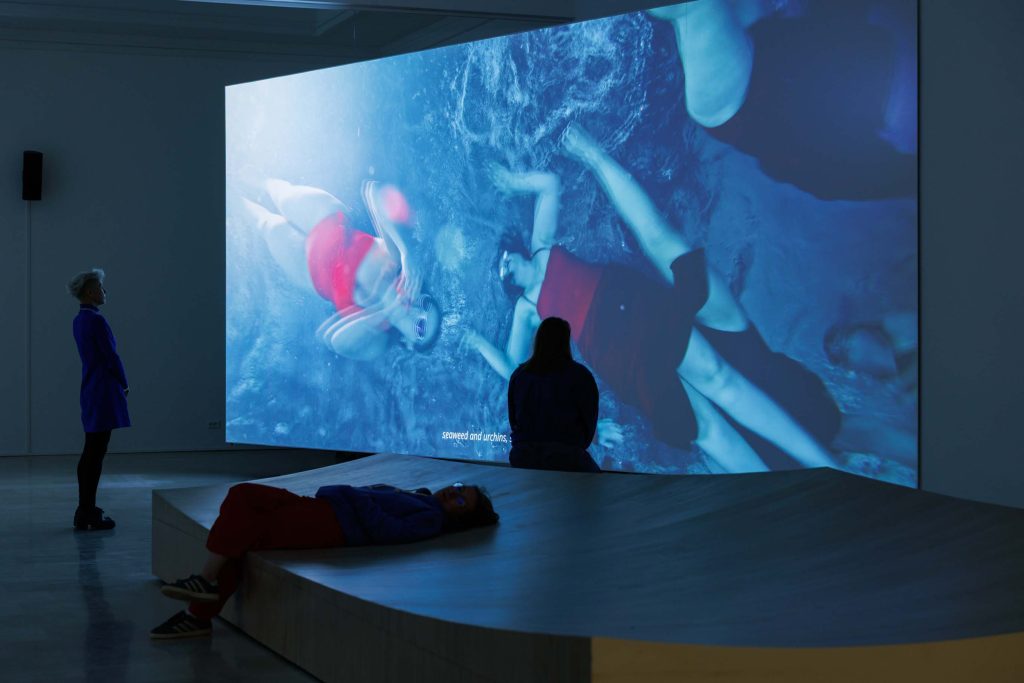
Bogna Burska and Daniel Kotowski, Liquid Tongues, 2026, installation view. Photo by Jacopo Salvi (altomare). Courtesy of Zacheta Archive and the Polish Pavilion.
The Polish Pavilion Liquid Tongues, by Bogna Burska and Daniel Kotowski, in turn, takes the form of an aquatic composition inspired by whale song. The video installation explores alternative modes of communication inspired by more-than-human life, particularly whale song, and drawing on Roger Payne’s landmark recordings Songs of the Humpback Whale (1970), which helped catalyze the modern whale conservation movement.
Eglė Budvytytė, in the Lithuanian Pavilion, likewise conceives her practice as an extended collaboration with the nonhuman. In her earlier work Songs from the Compost (2021), the performers’ garments were buried in the earth for months, allowing microorganisms to intervene in the material and leave traces of texture and color. Now, in animism sings anarchy (2026), filmed on the Mediterranean coast of Apulia, the clothes are shaped directly through contact with the landscape, as the performers “rub against the dusty walls and floors of ancient cave dwellings or immerse themselves in the salty seawater of Neolithic graves carved from coastal limestone.”(Louise O’Kelly, ”Shimmering, Quaking,” in Eglė Budvytytė: animism sings anarchy, exhibition catalogue (2026), p. 14.) Drawing on Lithuanian anthropologist Marija Gimbutas’s research, the three-channel installation, immersed in darkness, revisits Neolithic forms of life organized around fertility and reciprocal relations with the elemental world rather than patriarchal expansion and territorialization. Significantly, Gimbutas avoids the term “matriarchy,” distancing herself from the hierarchical logic embedded in the Greek concept of archē.(The ancient meaning of archē as both origin and authority has been associated with the archive as an institutional principle of classification and power by philosophers such as Jacques Derrida.)
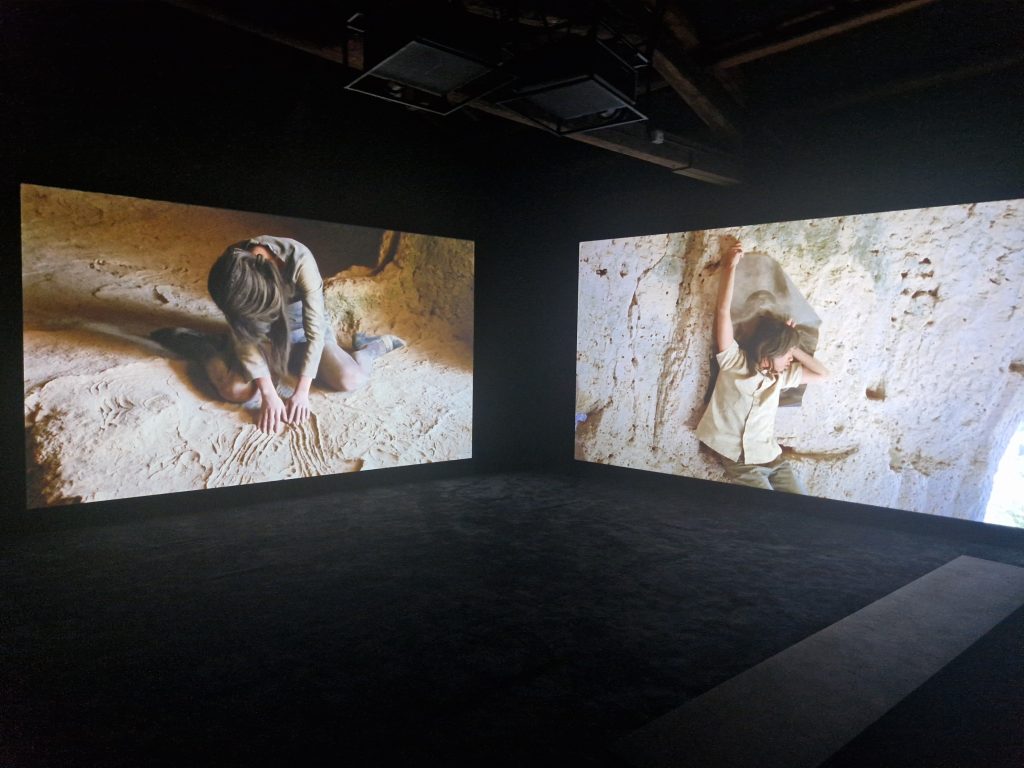
Eglė Budvytytė, animism sings anarchy, 2026, installation view. Photo by Raluca Oancea. Courtesy of the Lithuanian Pavilion.
Across these projects, phenomenology emerges as a privileged mode of inquiry grounded in experience, relationality, and embodied perception. Art thus becomes an embodied practice, activating phenomenological notions of earth and world alongside philosopher Maurice Merleau-Ponty’s concepts of reversibility and flesh, which describe the continuity between the human and the world while dissolving the traditional opposition between nature and culture. Reversibility starts from the uncanny experience of feeling–documented in the journals of artists such as Klee and Cézanne–that the nature one contemplates or represents is looking back upon you. It introduces an empowered nonhuman while revealing the shared flesh of the human and the world. In this context, classical human-centered ontologies give way to more fluid conceptions of existence, such as the “wet ontologies” proposed by geographers Steinberg and Peters.(Philip Steinberg and Kimberley Peters, “Wet Ontologies, Fluid Spaces: Giving Depth to Volume through Oceanic Thinking,” Environment and Planning D: Society and Space 33:2 (2015): pp. 247–264.)
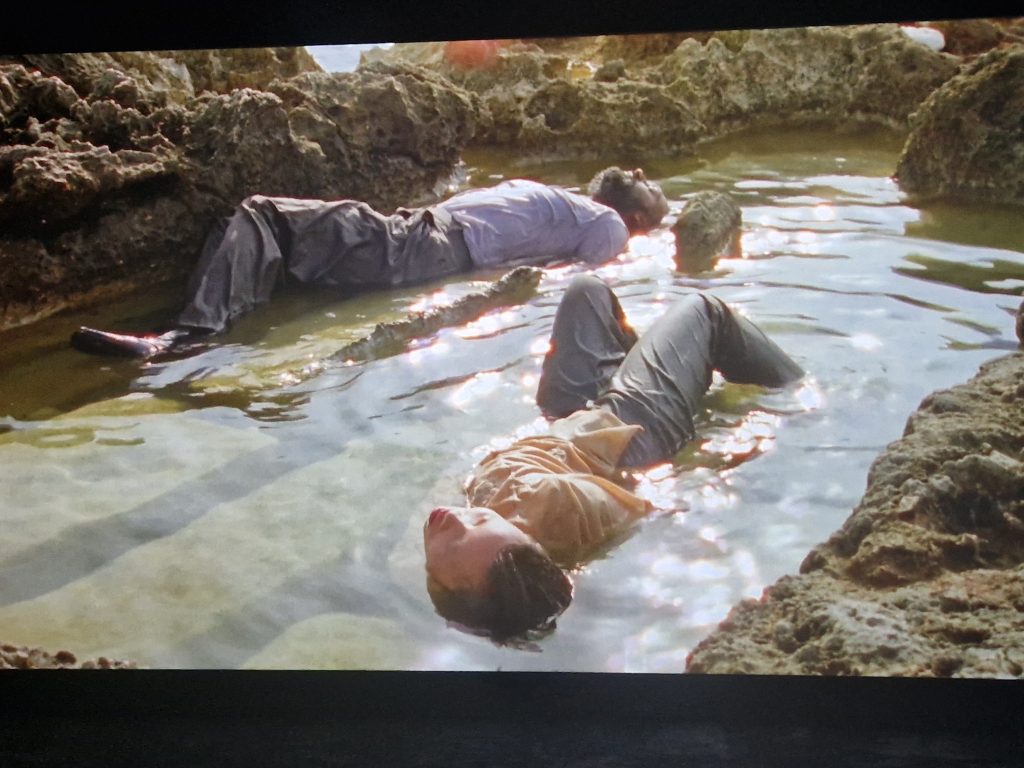
Eglė Budvytytė, animism sings anarchy, 2026, video still. Photo by Raluca Oancea. Courtesy of the Lithuanian Pavilion.
Why is a phenomenological approach particularly suited to these projects? Because they move beyond mere representation or the production of aesthetic pleasure and, despite their strong poetic and sensory qualities, they remain fundamentally forms of knowledge. This epistemic dimension makes phenomenology relevant, as it repositions art in relation to truth. Rather than simply representing the world, art brings a “world” into appearance, revealing its local, historical, and relational truths while preserving the opacity of the “earth,” the elemental and untamed dimension that continually escapes measurement, calculation, and human attempts to reduce it to functionality.
Understood in this way, the phenomenological “earth,” as the elemental dimension that resists conceptual ordering and totalizing control, approaches what poet and writer Édouard Glissant called the “right to opacity”: a resistance to the modern fantasy of a wholly transparent and explicable world, affirming instead the right of cultures and forms of life to remain partially opaque, preserving indeterminacy, depth, and mystery.
This tension between opacity and appearance is particularly evident in the Romanian Pavilion, Black Seas: Scores for the Sonic Eye, where the sea becomes a site of encounter between the elemental “earth” and the intelligible “world”. The pavilion poses what initially appears to be a simple question: what is a sea?, moving beyond the usual interpretation of a sublime landscape, a territory of refuge and contemplation for the urban subject exhausted by the density of dwelling? The artists thus initiate a “second sailing,” revealing less evident meanings: the sea as a mirror of the obscure layers of the unconscious, a restless archive of life and history, and a body of water traversed by violence, migrations, disappearances, and echoes impossible to reduce to the calm horizon.
In this context, read through the phenomenological tension between “earth” and “world,” the Romanian project Black Seas: Scores for the Sonic Eye allows two complementary perspectives on the sea to take shape. On the one hand, a poetic-elemental dimension emerges from concealment, oriented towards the opacity of the deep, towards ritualistic performance, abyssal music, and the geological temporalities of matter. On the other hand, a pole of lucidity asserts itself, where geopolitical analysis meets the scientific gaze of the oceanographer preoccupied with taking the measure of currents, mapping the waves, and capturing the turbulence of the sea into formulae.
This pole of lucidity first reveals the Black Sea as a space of historical confrontations, economic interests, and military strategies. Beyond its poetic imaginary, the sea has long functioned as both a frontier and a hub for the circulation of goods, resources, and political influence. Historic trade routes of wheat, tobacco, and slaves have given way to energy corridors carrying gas, oil, weapons, and nuclear materials. As the artists suggest, ports such as Constanța are inseparable from global energy policies positioning the region as a strategic corridor between the Caucasus, the Caspian Basin, and Europe, along with the geopolitical and ecological tensions they generate.(Ghiu, “‘Black Seas.’”)
This “world” emerges in both Black Seas installations through documentary footage: some filmed by the artists in port areas, others recorded underwater and drawn from the archives of research institutes.(The underwater footage was obtained with the support of the GeoEcoMar Marine Geology Institute, as well as researchers Mihai Baciu and Alexandra Hillebrandt-Voiculescu.) Together they reveal the infrastructures of extraction, militarization, and global circulation that connect seemingly distant places through the same extractive logic. In Blue Ground, this network is exemplified by the route of marine diamonds, carried from the African continent to the Atlantic and ultimately extracted by giant mining vessel like the Benguela Gem, built in a Constanța shipyard.
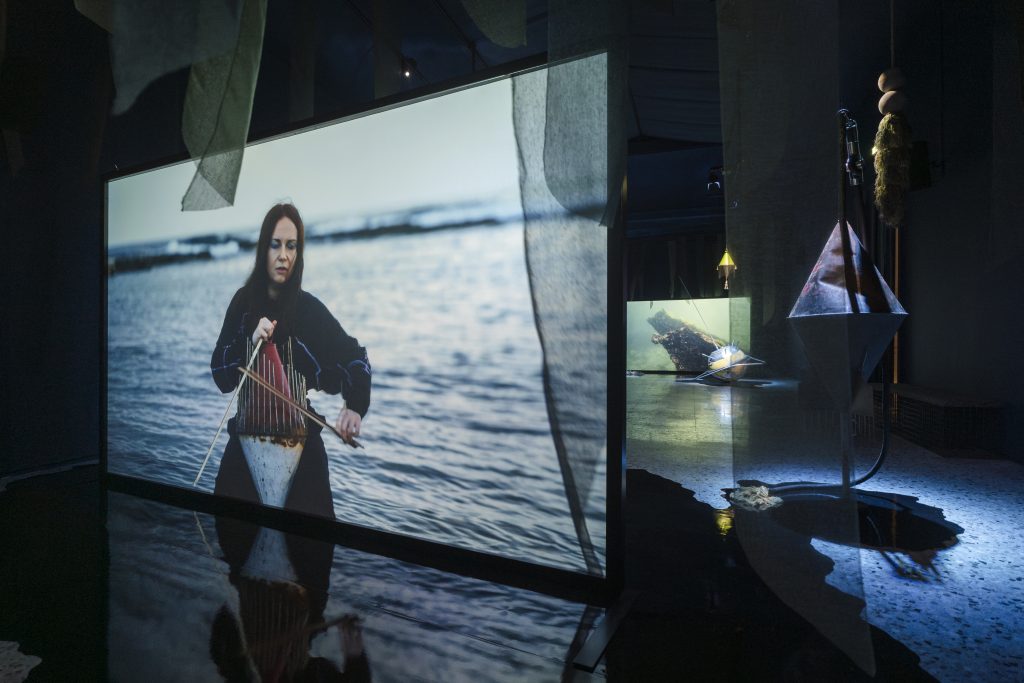 The constitution of the “world” continues through a network of artifacts. In How to Mend a Broken Sea?, the artists have assembled buoys, instruments used to measure currents and wave height for storm prediction, sonar prints displayed at the entrance to the Giardini Pavilion and embroidered with the routes of the rivers flowing into the Black Sea, together with the gravity core borrowed from the GeoEcoMar Institute. All of these function as material witnesses that render the sea intelligible. Yet the gravity core also complicates this logic. Beyond functioning as a scientific specimen, it perhaps becomes a witness through which the elemental “earth” inscribes its own memory: tens of thousands of years of geological history, including the formation of the Black Sea, when Mediterranean saltwater penetrated the former freshwater lake, radically transforming the region’s chemistry, salinity, and forms of life.
Although artistic research projects such as Black Seas involve substantial interdisciplinary collaborations,(In addition to the GeoEcoMar marine geology institute in Bucharest and Constanța, the team collaborated with the “Emil Racoviță” Institute of Speleology and the Underwater Exploration Group, and, last but not least, with the Oceanographic Research Institute in Venice.) they do not function as didactic illustrations of scientific knowledge. The relationship between “world” and “earth,” read alongside Glissant’s “right to opacity,” points instead to a more complex relation between art and science in a context marked by climate crises, geopolitical conflicts, and the destabilization of truth itself. Rather than reaffirming the modern ideal of universal, objective “Science,” these projects propose situated and relational forms of knowing, grounded in collaboration, local memory, and direct engagement with the environment.
This approach is particularly evident in the ways Benera and Estefán reactivate a form of knowledge akin to Indigenous science: “forms of knowledge built over time, through direct observation and an ongoing relationship with the environment.”(Ghiu, “‘Black Seas.’”) Likewise, Diana Miron’s sound performance recovers archaic folk melodies from around the Black Sea, transforming oral memory and the region’s collective vibration into another form of archive. A similar logic informs Eglė Budvytytė’s animism sings anarchy, which artistically reinterprets Marija Gimbutas’s archaeological research on the Neolithic water cult at Grotta Scaloria, reinforcing her vision of egalitarian communities centered on the regenerative force of nature.(O’Kelly, ”Shimmering, Quaking,” p. 14.)
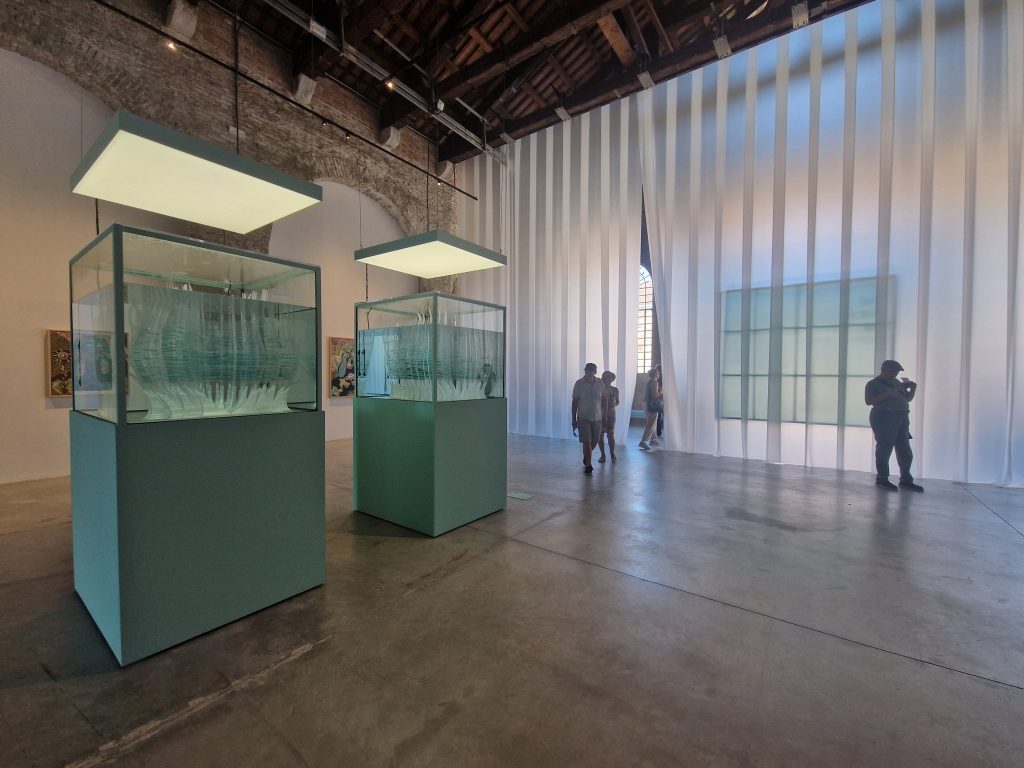
The Aural Sea, 2026, installation view. Photo by Raluca Oancea. Courtesy of the Uzbekistan Pavilion.
The political or scientific “world” also comes into view in the Uzbekistan Pavilion, The Aural Sea, which poetically documents the ecological catastrophe of the Aral Sea resulting from Soviet water diversion projects, housed within a turquoise-blue pavilion featuring Nguyen Phuong Linh’s living landscapes printed on translucent PVC sheets that move and breathe, alongside a salt installation by Zi Kakhramonova that invites visitors to create fish-shaped forms in memory of the lost ecosystem. It also appears in Jenna Sutela’s Aeolian Suite, through meteorological data, wind recordings from Venice and Helsinki, and the classification of the five Venetian winds—Tramontana, two Boras, Scirocco, and Garbin.
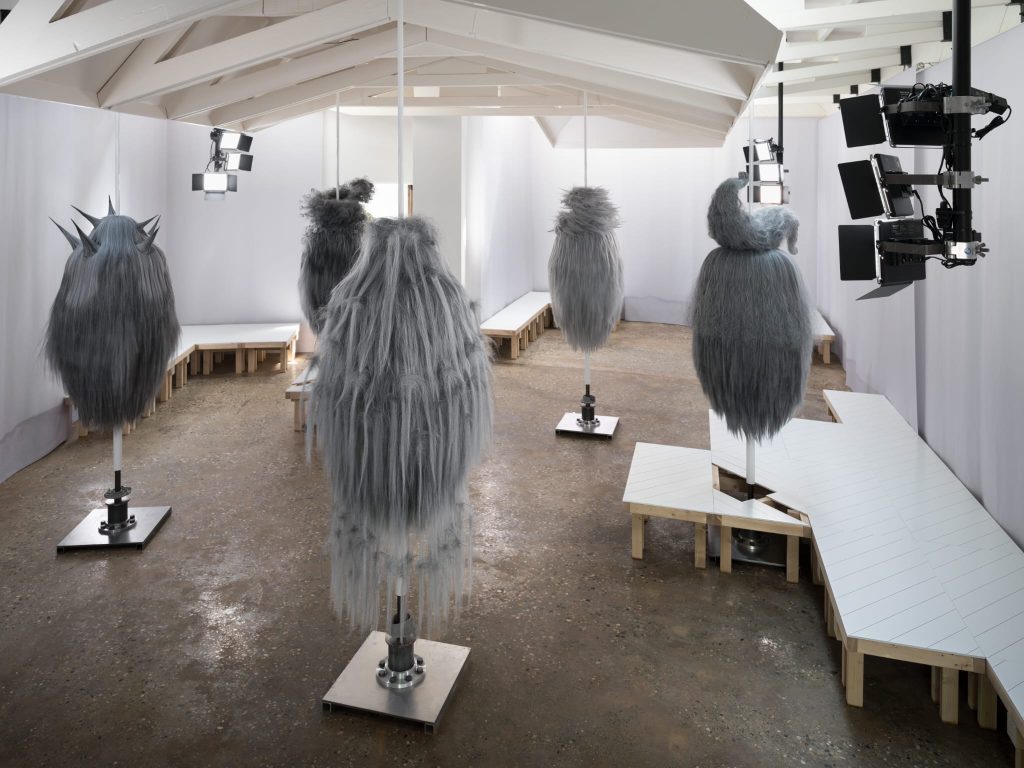
Jenna Sutela, Aeolian Suite, 2026, installation view. Photo by Ugo Carmeni. Courtesy of Frame Contemporary Art Finland.
If these projects construct a “world” through scientific, historical, and vernacular forms of knowledge, the complementary perspective of the “earth” emerges through an elemental poetry that resists complete explanation, singing of the soil’s opacity, the imponderability and unpredictability of the winds, and the brute force of waves and invisible currents from the deep. Included here are the Dionysian, indecipherable chants that surpass the logic of language in Liquid Tongues; the sound of the wind in Aeolian Suite, untamed despite every attempt at classification; the playful, utopian devices for capturing air; and the lyrical, almost abstract footage of ascending vapors that dominates an entire wall of Pneuma Cosmic.
This elemental and opaque dimension of the deep and the fluidity of wet ontologies also unsettle the human coordinates through which space and identity are conventionally organized: fixed boundaries are suspended, making identities mobile and space no longer a homogeneous container. The structure of the Lithuanian pavilion adopts, in this sense, the shape of a circular labyrinth, an organic morphology that, although shrouded in darkness, provides a sense of safety, as if one were hidden in the heart of a snail shell or the center of a protective cave. Along the irregular spiral, the three video channels engage in a meandering dialogue, allowing sound and images to circulate unhindered. Uncanniness and organicity also mark these films, in which the performers’ bodies are immersed in the forest, plunged into shallow pools that seem to have belonged to a lacustrine cemetery, swept up in a permanent “tender tremble,” as the curators describe it – a ritualistic dance or convulsion at the border between life and death, between the “world” and the “earth”.
The entire scenography of How to Mend a Broken Sea?, plunged into darkness, directionally lit, and dominated by Diana Miron’s ritual-like performance, functions in the same register. The artist sings with the sea, responding to the waves in a relation of reversibility. Her feet sink ever deeper into the water, rooting themselves in the sandy seabed. Her wet, worn garments take on the color of algae. Her voice breaks into increasingly staccato breaths and cries, abandoning the register of the pleasant and the rational as it descends into darker, more Dionysian tones. Her body seems on the verge of dissolving, becoming a body of water.
In a haunting shot filmed from above, the artist floats offshore in a map-dress the color of sea foam. Her flesh becomes an island within the marine archipelago. For a moment, the tension between “world” and “earth” surfaces: the human desire to territorialize and explain the sea collides with waters indifferent to human history. Aligned with geological time, the deep prepares to absorb the fragile body, dissolving it into its saline matter.
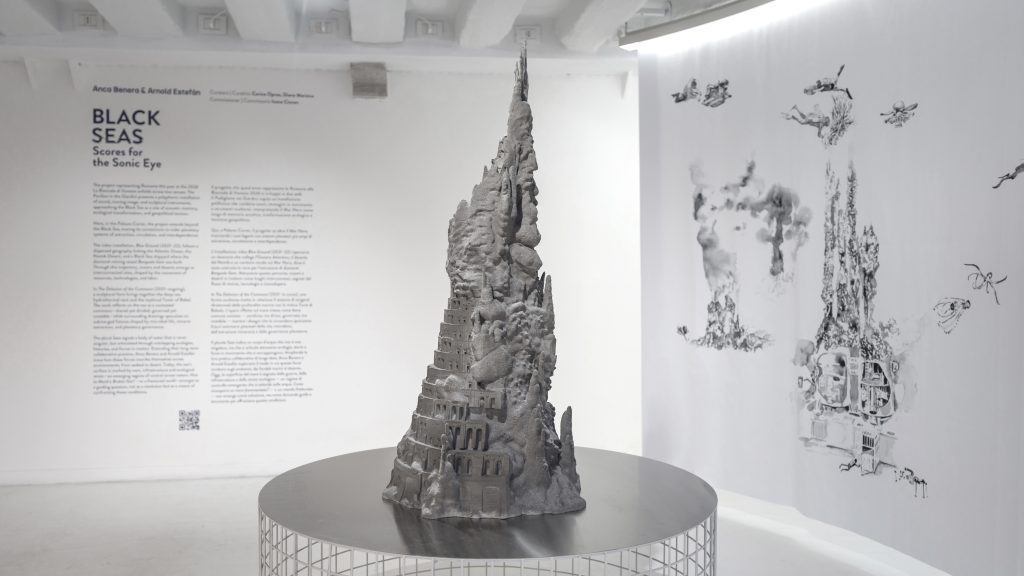
Anca Benera and Arnold Estefán, 3D-printed sculpture Delusion of the Commons, 2026. Photo copyright Samuele Cherubini.
The tension between the human “world” and the elemental opacity of the “earth” also informs the 3D printed artifact accompanying Blue Ground, through its sand-like texture and its form that hybridizes the Tower of Babel with the image of a marine hydrothermal vent: a submarine geological formation through which life bursts from the depths, forming black smokers and ecosystems sustained independently of light and photosynthesis. Likewise, the narration of the Blue Ground scenario from the perspective of a traveling diamond(We note here the origin of the word “diamond” in ancient Greek, where adamas means untamed, hence the meaning of perfect and eternal matter.) poetically inverts extractive logic: matter gains agency and voice, escaping the capitalist economic circuit.
The dense symbolism of the artifact in Blue Ground finds an echo in Budvytytė’s Lithuanian Pavilion, where the video installation centers on a series of small earth-colored figurines combining anthropomorphic silhouettes with grotesque vegetal or animal abundance, disrupting “the modern regime of binarized gender legibility and its false claims on timeless universality.”(Amelia Groom, “Stone Age Butch Blues: Nonbinary Prehistory and Futures for the Neolithic Monster Goddess and her Genders,” in Eglė Budvytytė: animism sings anarchy, p. 44.) Their story takes a paradoxical turn at the end of the film, when the performers contemplate a 3D printer producing the very same figures inside an ancestral cave.
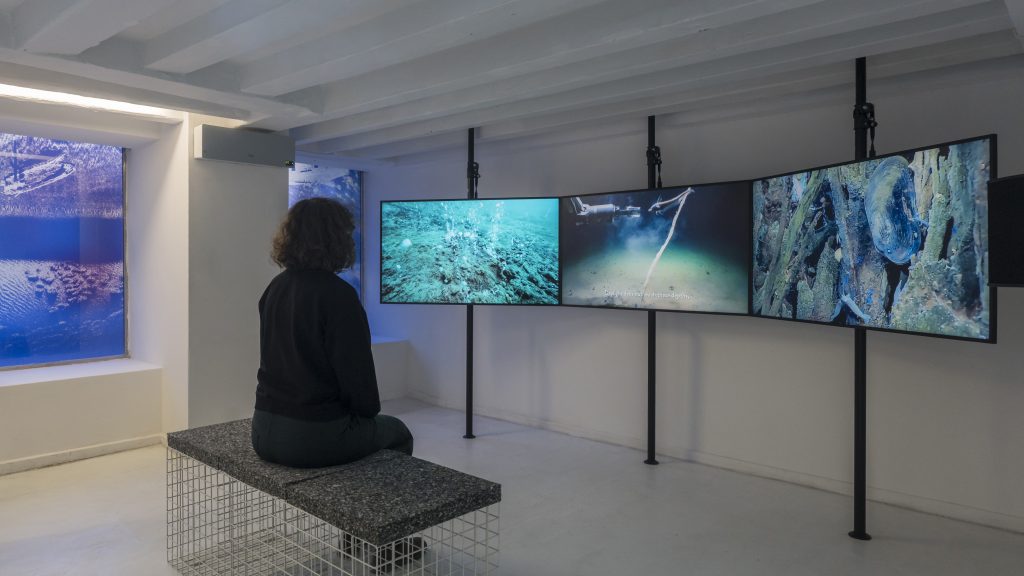
Anca Benera and Arnold Estefán, Blue Ground, 2026, video installation. Photo copyright Samuele Cherubini.
In Black Seas: Scores for the Sonic Eye, the ancient Greek name of the Black Sea, Pontos Axeinos (“the inhospitable sea”), also points to its wild, opaque dimension, resistant to human ordering. Its radically stratified structure reinforces this condition: an oxygenated surface sustaining life and circulation coexists with an anoxic depth saturated with hydrogen sulfide, where the life of complex organisms becomes almost impossible, and decomposition slows almost to the suspension of time itself. The sea thus becomes a space of sedimentation, where the decipherable surface overlays an opaque deep preserving traces of the past.
Accompanied by Simina Oprescu’s sonic composition of low frequencies and visceral bass pulsations, the footage from the anoxic depths no longer reads as scientific documentation. Instead, the oceanographic phenomenon of turbulence appears as an expression of the “earth”: untamed elemental energy. Structured around deep resonances evoking geological, more-than-human time, in which the history of the Black Sea must be read, the second video channel of How to Mend a Broken Sea? culminates in an explosion before plunging to a microscopic scale. The final frames of the video reveal white, almost abstract images of cyanobacteria, microorganisms associated with the origins of photosynthesis and the transformation of the Earth’s atmosphere. Their slow dance, accompanied by the appearance of graceful oxygen bubbles, discreetly points to the primordial memory of life, suggesting once again that the sea is not merely surface or landscape, but a stratified, living, and profoundly archival organism.
Turbulence also becomes a metaphor for the region itself: wars, migration, energy infrastructures, ecological crises, and the continuous circulation of power. In this sense, the opacity of the “earth” opens onto the broader themes of concealment and death that traverse the Biennale, through an ecological imagination shaped by darkness, pain, and the uncanny, and, inevitably, by the untimely passing of Koyo Kouoh. It is perhaps no coincidence that many of the strongest pavilions, including those of Romania, Lithuania, and Poland, are plunged into darkness.
Yet death is consistently approached in a minor key: not as an absolute end, but as transformation and latency. The anoxic depths of the Black Sea make this especially clear. Oxygen deprivation signifies death for some organisms while creating the conditions for others to exist. Likewise, resurrection ecology research in the Baltic Sea has reactivated microscopic algae after nearly 7,000 years of dormancy, destabilizing any simple definition of death. This understanding of death as transformation rather than rupture also extends to the Neolithic magic-animist imaginaries in Budvytytė’s Lithuanian Pavilion, which invite us to learn how to die by understanding death as a shift in temporality and a return to the broader cycles of nature, thereby challenging the contemporary capitalist denial of death .
We arrive, finally, at the archive as another important structure of the minor keys. Several elements of the Black Seas pavilion foreground the project’s archival character. The sea itself, as both the origin of life and a funerary space, appears simultaneously as a place of memory and disappearance, transforming black from a simple chromatic quality into a sedimentation of histories, phantasms, and lost bodies; the collection of buoys, floats, gravity cores, and recycled marine materials embodies what Hal Foster calls the “recalcitrantly material” character of the archive,(Hal Foster, ”An Archival Impulse”, October, vol. 110 (Autumn, 2004): pp. 3-22.) attesting to a more-than-human history inscribed in matter and evoking a past that persists spectrally, resisting definitive interpretation. Moreover, the anoxic layer–described by the artists as a “ghostly archive”–recalls Derrida’s understanding of the archive not as a neutral repository of the past but as a site where preservation, aggression, and disappearance coexist.
But if the official archive establishes and legitimizes a particular order and interpretation of the world, the anoxic depth functions as an elemental, non-anthropocentric anti-archive: a space where bodies, sediments, shipwrecks, and organic remains are preserved without being ordered, classified, or integrated into a stable, transparent memory. It preserves while suspending, slowing decomposition without turning its remains into definitive documents or truths. The sea thus becomes the opposite of the modern archive: it does not clarify, stabilize, or impose a total order of meaning.
Perhaps the most compelling inversion with tactical media valences is the “sonic eye” from the pavilion’s title. Pointing toward sonar technologies, inspired by marine mammals’ echolocation and later co-opted for the mapping and military control of waters, the formula reclaims a technology of power against its own logic. Sound ceases to be an instrument of measurement and becomes a form of critical listening, unmasking invisible infrastructures of extractivism and bringing into presence life forms, temporalities, and histories that dominant discourses reduce to background noise.
This logic characterizes all the Biennial pavilions discussed above, which transform the archive into a critical or anti-archival practice. Rather than consolidating official histories, the projects collect the sound of the wind, whale songs, traces of ancient water cultures, or testimonies to the death of the Aral Sea in order to construct alternative ecological and historical narratives and reactivate the archive as a site of resistance rather than classification.
Across the projects discussed here, the sea, the wind, and the earth cease to function as mere settings for human action. They emerge instead as agents, witnesses, and collaborators in the production of history and knowledge. In this sense, Kouoh’s “minor key” is not a metaphor of marginality but an ethics of attention, one that redirects perception toward elemental forces, overlooked temporalities, and more-than-human forms of existence. The Biennial invites us to look with our ears and to listen with our entire body. Its most profound lesson is perhaps to inhabit the world as a network of relations, currents, voices, and depths, where life and death appear not as opposing states but as different rhythms of the same matter in continuous transformation.