Tagged: ecology

The Venice Biennial: On Black Seas, Dead Waters, and Ghostly Archives

Art projects built on shock and sexuality, such as those presented by Austria or Denmark, have generated extraordinary buzz in the coverage of the 61st Venice Biennial. These projects do not, in my view, fully engage with what Koyo Kouoh, the late Cameroonian curator trained in Switzerland and known for her decolonial approach, defines as the “minor key.” Rather, a posthumanist perspective that rethinks human and nonhuman relations beyond anthropocentric and Eurocentric frameworks lies closest to Kouoh’s curatorial program, which was informed by references to writers Édouard Glissant and Toni Morrison and structured around metaphors such as “the archipelago,” “the … Read more

Visualizing the Transformation of Nature in Central Asia: Socialist Anthropocene in the Visual Arts (SAVA) Roundtable

This roundtable brought together Aïda Adilbek, Aziza Kadyri, Aigerim Kapar, Anel Rakhimzhanova and SAVA Creative Fellow Saodat Ismailova to discuss the environmental transformation of Central Asia during the Soviet period and its contemporary ramifications through the lens of artistic, curatorial and academic research. Held at UCL on May 29, 2025, the conversation was led by Maja Fowkes, and attended by SAVA Team members Reuben Fowkes, Makar Tereshin, and Sorcha Thomson.

Maja Fowkes: I’m a Croatian-British art historian, I was born in Socialist Yugoslavia and my grandma used to make me a tea I loved, which she called Russian tea. When

… Read more

Christa Jeitner’s Visions of Trees

My first encounter with Christa Jeitner’s work Zakopane Tree (Zakopanischer Baum) was a black and white photograph of an outdoor scene in nature. It shows a hanging textile work in the center. Attached to almost leafless branches, the triangular fabric body hangs in the air while its ends rest on a field floor of stones and grass. Apart from a few tall, vaguely recognizable trees in the background, the upper part of the photograph is almost white, so that the dark branches and the light-colored fabric stand out strongly. Dated to 1979-80, this work was created by Jeitner … Read more

Earth, Matter, Rhythm: Władysław Hasior and the Socialist Anthropocene

Recent years have brought significant developments in the research on the neo-avant-garde beginnings of environmental art in Poland.(Among them is an upcoming book by Magdalena Worłowska on the beginnings of environmentally engaged art in Poland. See: Magdalena Worłowska, Początki sztuki ekologicznie zaangażowanej w Polsce (Warsaw: Akademia Sztuk Pięknych w Warszawie, Muzeum Sztuki Nowoczesnej w Warszawie, 2025).) The scholarly interest in the rise of ecological awareness in the country at the turn of the 1960s and 1970s—and its reflection in art—comes together with the perceived need to rewrite the history of Polish culture so as to illuminate its multiple … Read more

The Socialist Anthropocene in the Visual Arts: Online Special Issue Introduction

This special issue spanning ARTMargins Online and ARTMargins Print Journal derives from the ERC/UKRI supported project on the Socialist Anthropocene in the Visual Arts (SAVA) that foregrounds the contribution of environmental art history and research-driven contemporary ecocritical art to the interdisciplinary inquiry and epistemic endeavor of the Socialist Anthropocene.(The Socialist Anthropocene in the Visual Arts (SAVA) project is led by Maja Fowkes at UCL Institute of Advanced Studies; see: www.sava.earth.) The Socialist Anthropocene denotes a field of collective inquiry into the sociopolitical, geoeconomic, biocultural, and ecological ramifications of changing relations with nature under socialism. Resisting the tendency to … Read more

Grafting Solidarities – From the Factories to the Fields

Matter of Art Biennial 2024, Prague, June 14 – September 29, 2024

Six years ago, the Czech section of the Tranzit network launched a new art biennial in Prague titled Matter of Art, currently in its third edition. In contemporary times, nearly every major city hosts biennials to foster local cultural vitality, generate tourism, and enhance the city’s international perception and influence. Each new initiative sparks inquiries into its objectives, content, and audience, at home and globally. This constant self-reflection is especially crucial for biennials in East Central Europe—such as the Biennale Warszawa, Kyiv Biennial, OFF-Biennale Budapest, and Survival … Read more

One on One: Interview with Anna Zilahi, Missa Echologica (2021)


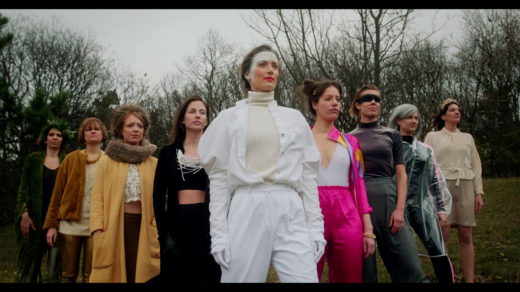
This podcast is part of the One on One series, which presents timely encounters between ARTMargins Online editors and contemporary artists, focused on one work.  It was recorded on the occasion of the recent online release of Missa Echologica, a video piece. Zsuzsa László interviews the Hungarian artist and poet Anna Zilahi who created this work in collaboration with Laura Szári and the Varsányi Szirének feminist choir (Blanka Bolonyai, Dóra Ferenczy, Bettina Horváth, Dóra Király, Rita Szántó, Laura Szári, Diána Takács, Eszter Tóth, Virág Török, Anna Zilahi). Gergely Ofner was in charge of photography. The work was introduced … Read more

In Search of Parallel Worlds: A Portrait of Ilija Šoškić

Ilija Šoškić, born in 1935 in present-day Kosovo (then part of Yugoslavia), and raised in present-day Montenegro, became the most known representative of the Montenegrin neo-avant-garde, although the artist would never call himself that. Rejecting any nationalist aspirations of the post-Yugoslav states, he sees himself instead as a nomad or a pilgrim(I refer to the title of Šoškić’s performance Pilgrimage (Hero’s Walk), from a 1975 performance realized at the Hohenzollern Castle, in Tubingen, Germany.)—somebody constantly on the road. Nevertheless, he has returned on several occasions to Montenegro and currently is based in neighboring Croatia.

Šoškić’s actions, installations, and … Read more