Longing for the End of Empires: Eglė Budvytytė’s animism sings anarchy at the 2026 Lithuania Pavilion in Venice
Eglė Budvytytė’s animism sings anarchy presented at the 2026 Lithuania Pavilion in Venice takes the form of a three-channel installation complemented by a minimalist but experiential exhibition design and some additional sculptural elements alluding to the content of the films. Result of a multi-layered research project, it engages with the feminist reinterpretation of the Neolithic in Europe carried out by Marija Gimbutas, a prolific mid-century Lithuanian-American anthropologist and linguist. Gimbutas’s visionary and often provocative research on matrilineal societies and their peaceful potential found resonance within some feminist currents as well as wider public in the 1970s-1980s.
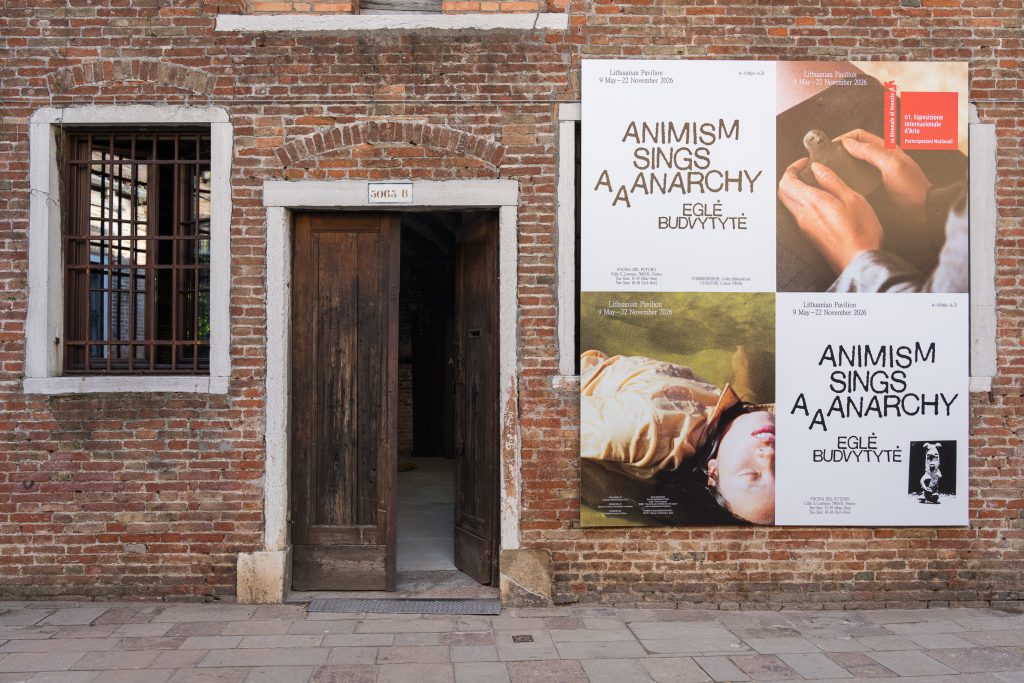
Eglė Budvytytė, Lithuanian Pavilion, La Biennale di Venezia, 2026. Photo: Andrej Vasilenko. Courtesy Lithuanian National Museum of Art.
Born in Kaunas, Lithuania in 1981, Eglė Budvytytė is an interdisciplinary artist based in Amsterdam. Her practice combines choreography, video, sound, and poetry which all aim to articulate embodied explorations of eco-feminist and post-humanist themes, as well as, more recently, the ritual as an atemporal spiritual tool. Budvytytė comes from a background of photography and was further trained at Gerrit Rietveld Academie. Several aspects of her work reflect the influence of eco-dramaturgy as well as of the concepts of somatic dance developed within Amsterdam’s creative scene of the 1990s and 2000s. animism sings anarchy is curated by Louise O’Kelly, London-based curator and a founder of Block Universe, an initiative that commissions innovative performance and leads the eponymous visual art, dance and music festival in London.
Attuned to the theme of this year’s Biennale, In Minor Keys, curated by Koyo Kouoh, the pavilion resonates with one of its key leitmotifs: mourning. Through the gesture of whispering and gentle trembling, it evokes burial rituals and reflection on death that run subtly through Budvytytė’s animism sings anarchy.
Over recent years, the artist has used the tropes of paganism to build a compelling ecocentric argument. In particular, in Song from the Compost, presented at the 2022 Venice Biennale as part of The Milk of Dreams exhibition in the Arsenale, Budvytytė developed the idea of death as a transformative process of inter-species symbiosis, setting its crawling and dragging choreography in the forest and along the cost of the Curonian Spit natural reserve. However, in this new project, she appropriates the performative dimensions of ritual to go beyond the environmental framework, as Budvytytė is now clearly aiming to use multiple temporalities to expand her usual research of the forms of knowledge gravitating between the landscape and body gesture.
Two main parts of animism sings anarchy were filmed in Gargano, in the Southern Italy region of Apulia, near Grotta Scaloria, and in an archaeological museum in Rome. Grotta Scaloria is an important natural and archaeological site with numerous artifacts and human remains relating to the Neolithic period. The cave was discovered in 1931 and since then scientists have been analysing tools, pottery and burials present in its two chambers. Between 1978 and 1980, Gimbutas conducted an excavation in the cave and articulated a new hypothesis concerning its significance as a sanctuary and supposedly a site of a water cult. This interpretation was integrated in her general set of archeo-mythological propositions and used in her argument about matrilineality in the Neolithic. One of the key points in her reading of the cave was the presence of the vessels placed as if to collect water falling from the stalactites. This aspect was the one that particularly fascinated Budvytytė, because it represents the essence of the vessel in its purpose of collecting and keeping and bears associations with the cave as a womb. Indeed, the screening room that hosts her film at the pavilion echoes the shape of a grotto. Its interior walls feature a pattern of excavations carried out by Gimbutas, perforated with dots of different sizes and giving the interior a certain volume. Next to the entrance to this cradle-like space, the artist also positioned an ominous wax sculpture with a pulsating, retro-illuminated surface that gives an additional nod towards the motif of keeping and collecting, as well as deriving from the fact that the real grottos in the film have a resemblance to the honeycombs when seen from the sea.
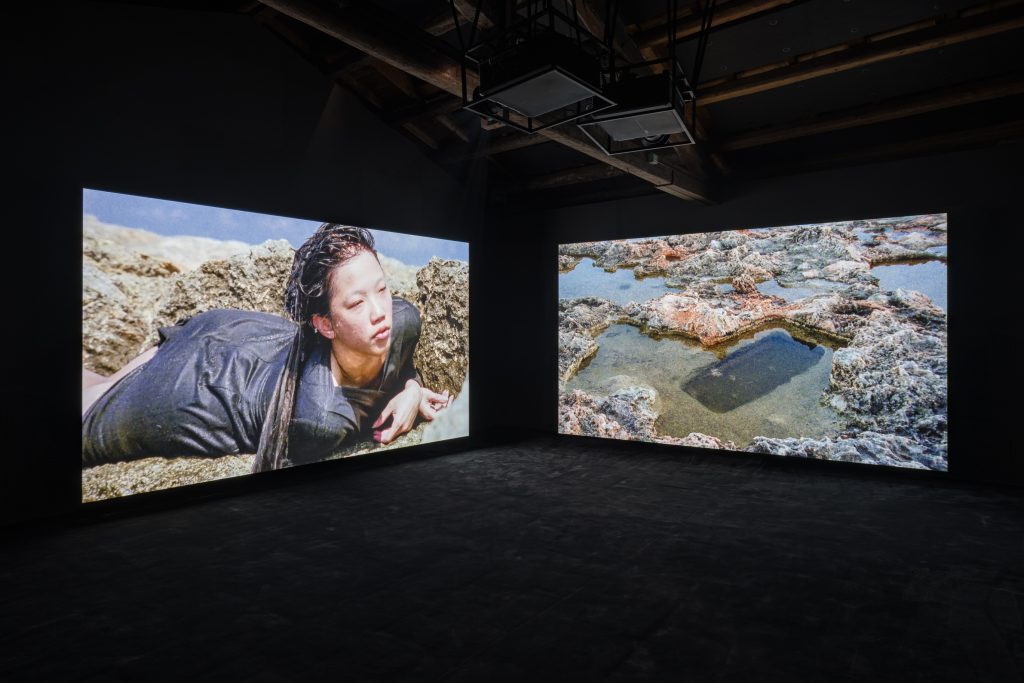
Eglė Budvytytė, installation view, animism sings anarchy, Lithuanian Pavilion, La Biennale di Venezia, 2026. Photo: Andrej Vasilenko. Courtesy Lithuanian National Museum of Art.
The film’s aesthetic is highly textural. Filmed on 16mm, every element, including light, costume work and photography, resonates strongly with the rocky Apulia landscape and its nature. It captures performers as they are carried through a sequence of enigmatic rituals: gathering in a dusty cave to observe a small, gender-ambiguous deity figurine being produced by a portable 3D printer; pressing and rubbing its image against the walls of the cave as if to transfer their grain to the paper; or being carried away by a synchronised trembling movement.
In another sequence, their bodies slowly soak in the sea-facing area of the grotto as they skim printouts of ancient pagan sculpture across the water, crawling through rock pools that resemble both salt pans or grave-like vessels. The culminating synchronised scene shows them dancing ankle-deep in water on a rock shelf facing the sea, before collapsing in unison, only to resurface on another channel of the video, this time in a museum hall filled with pre-historic vessels and sculptures. There, they march and climb through the rooms in a trans-like choreographic phrase. The performers are dressed in student attire or retro office-worker clothing, moving across the screentime in undulating motions, seemingly absorbed by an occult force that drives them into deep introspection.
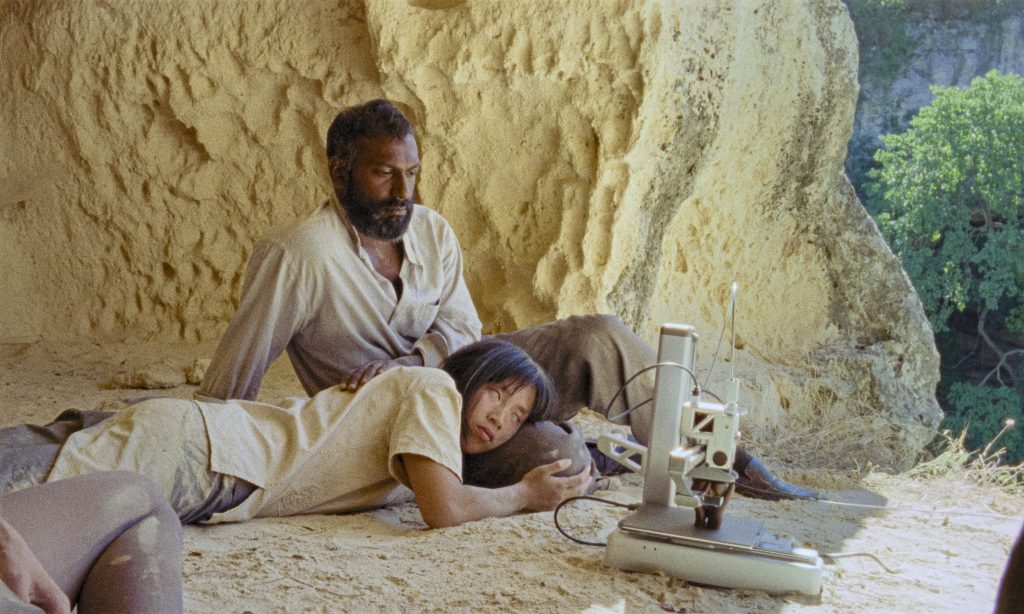
Eglė Budvytytė, animism sings anarchy, 2026. Three-channel film installation, 16 mm film transferred to 4K projection, 40 min. Copyright: Eglė Budvytytė, 2026.
On the conceptual level, Budvytytė seems to treat the work of Gimbutas, and in particular her study of Grotta Scaloria as a working archive and a powerful set of visual meanings to reclaim and make use of. The part of the film set in the grotto immerses the viewer in the realm of archaic beliefs and temporarily erases the scientific dimension of knowing by giving space to narrative-free imagination. It transforms questions about how old the earth, water, rocks, and all that surrounds us are, and where we come from into sensory wanderings. The performances filmed in the grotto were conceived by the artist as a way to experience grounding in the present, as opposed to the accelerated time we now live in due to the amount of information and travel that define contemporary experience.
The film’s rhythm, according to the artist, her performance team and the curator, was influenced by the materiality of the places where it was shot. Indeed, it reiterates Budvytytė’s years-long pursuit for voicing space and natural environment. As in Song from the Compost, she uses poetry that is at times sung and at times detachedly mumbled, while the being behind this digitally altered voice remains fluid yet unflinching in its post-humanist agenda. One of the references for developing these choreographies was Édouard Glissant’s concept of ‘trembling thinking,’ a philosophy of uncertainty to be embraced once fixed identities and colonial ways of seeing and understanding the world have been shaken off. In animism sings anarchy it is used as a metaphor of instability and fragility.
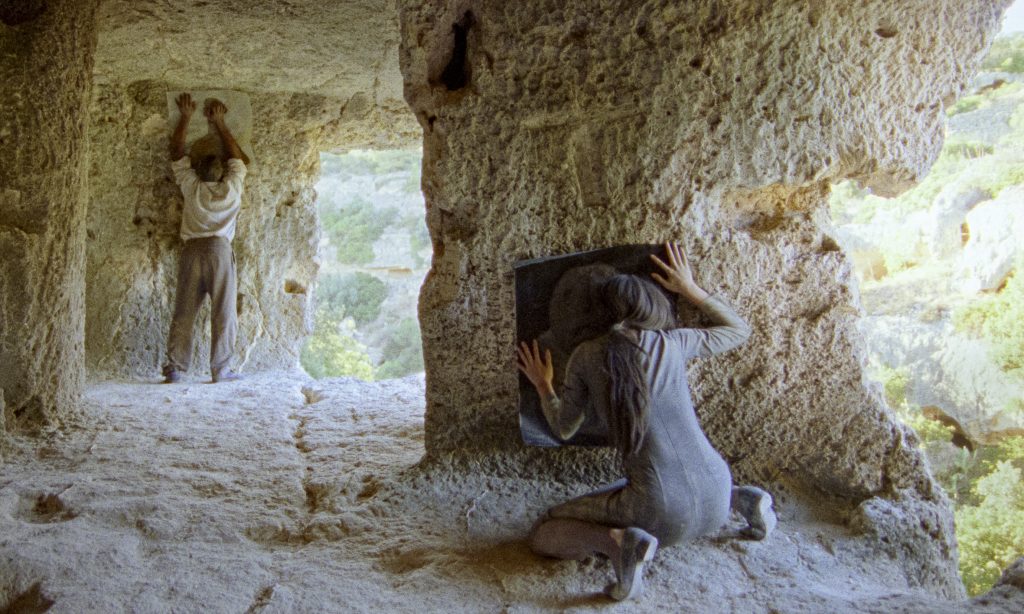
Eglė Budvytytė, animism sings anarchy, 2026. Three-channel film installation, 16 mm film transferred to 4K projection, 40 min. Copyright: Eglė Budvytytė, 2026.
As for the use of Gimbutas’s ideas as the guiding reference in the pavilion, it received a deserved closer examination, particularly given her prominence not only as a scholar but also as a public figure. She gained considerable popularity beyond the academic field within the momentum when esoteric, ecological and feminist thought were confluent, in particular in the United States, and to different extents, were all moving towards occupying more public space. Gimbutas appeared actively on television and radio, gave public lectures and used these means to advocate her archaeo-mythology (archaeology enriched with sometimes deliberately conjectural forms of cultural history) and in particular, her readings of the archaeological world around the concept of the great Goddess. In some sense, Budvytytė’s dialogue with Gimbutas’s legacy is an attempt to recover it from its controversies within the way it was appropriated by the transphobic currents of feminism, as underlined by Amelia Groom in the exhibition catalogue.(Eglė Budvytytė, Tender Tremble, Bom Dia Boa Tarde Boa Noite, 2026.)
Yet the most intriguing aspect of Budvytytė turning to Gimbutas’s legacy lies in what both Gimbutas’s own writing and the testimonies of her colleagues suggest: namely, that her interpretations of Neolithic figurines were shaped by her early exposure to Baltic folklore and by the embeddedness of pagan elements in everyday life. Singing, in particular, is one of the most powerful ways through which the religious and magical realm can enter, be invoked within and remain in the quotidian through generations. These influences have been important to the development of Budvytytė’s recent works, beginning with the Song from the Compost.
Landscape represents another core element of the artist’s practice and reflects her earlier preoccupation with the domain of public sphere in the performances and interventions from 2015 to 2017, which were designed to question social structures and act as disruptive gestures within them. Lately, the settings of Budvytytė’s fragmented choreographies are also becoming more and more filled with agency, (re)enacting a speculative version of the past or future. In comparison with her previous films with apparently neutral setting, animism sings anarchy engages actively with time, be it a museum or a cave that was once a devotional site. It dives into fabulatory mythology, which both throws us back in time to something primordial, and allows the artist to articulate an urgent political statement.
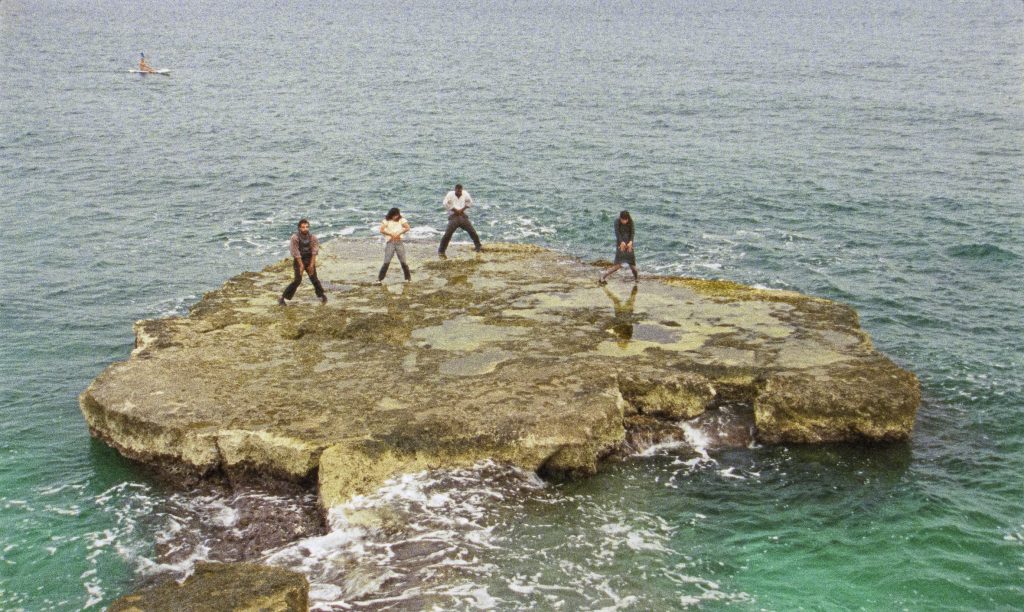
Eglė Budvytytė, animism sings anarchy, 2026. Three-channel film installation, 16 mm film transferred to 4K projection, 40 min. Copyright: Eglė Budvytytė, 2026.
Budvytytė had already worked with fictionalised time while creating sung poetry, or scores, as she calls it, in preparation for filming Song from the Compost, for which she admits having been inspired by the literature of Octavia Butler, and in particular by her novel Dawn (1987). Part of a post-apocalyptic trilogy, the novel tells the story of humanity’s survival though hybridisation with an alien species and inspired the artist to compose Song’s poems as a series of ‘love letters’ to Butler and Lynn Margulis, the author of the theory of symbiogenesis in evolutionary biology. The way she approaches language in animism sings anarchy, both in her scores-poems and the choreography, builds upon the method she developed in this earlier film. In relation to that work, she compared language to compost as something mouldable and layered, while the language of the body, dance and movements is conceived by the artist as mimicry.
It is evident that one of the artist’s main concerns in her pavilion project is the epistemic dimension of ritual, and in her work a fictional ritual becomes an ideal space in which to enact in-betweenness and porosity, both in temporal and physical senses. For anthropologists, ritual is a social tool used to mark a meaningful event in the life of an individual or a group, and in many cases this event signifies a transition from one phase to another, from one condition to another. Since Arnold van Gennep’s work The Rites of Passage, and particularly its re-actualisation in the 1960s, ritual has been understood as an essential cultural expression of this liminality. In Budvytytė’s hands, the idea of ritual is freed from any specific cultural meaning and used as an expressive tool through vocalisations and choreography. It is treated as a container (a vessel of its kind) that can open onto the artist’s preoccupations and political agenda, combining ecological anxiety, the rejection of current military conflicts, and concern over the rise of ultra-conservatism and authoritarianism across the world. Budvytytė’s reflections on gender, anthropocentrism, and death all converge in animism sings anarchy, resulting in a compelling, if slightly cryptic, work of art. The viewer is lured into the archaic atmosphere of the Mediterranean cave, yet the real artistic intent here only unfolds somewhere between the trembling dance and the texts of the chants performed in the artist’s trembling voice.
Most of Budvytytė’s choreography in her film is centred on the body that is being moved as opposed to the body that is moving. The choreography was developed from the chants-prayers created by Budvytytė using voicecoder. At times ironic and at times sensual, both chants and movements are used by the artist as metaphor for the body open to the beyond-natural forces and becoming a kind of spiritual channel. These chants serve as a score for the choreography, which is deliberately driven by the logic of unlearning and letting go and, according to O’Kelly, by ‘working through the body’ and therefore working ‘somatically.'(Budvytytė, Tender Tremble, Bom Dia Boa Tarde Boa Noite, 2026.)
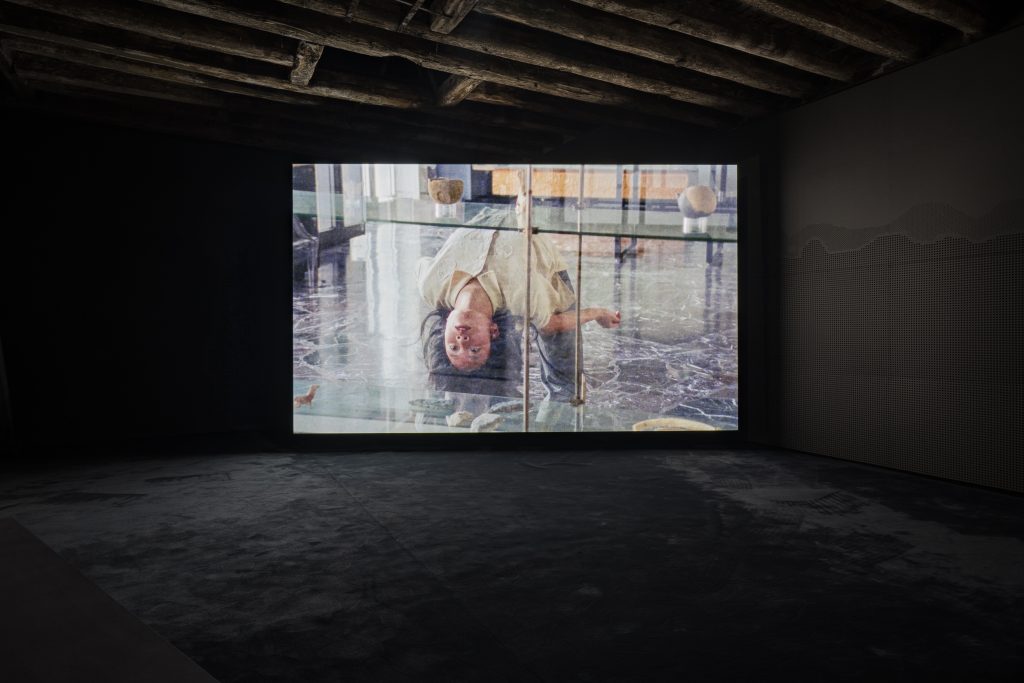
Eglė Budvytytė, installation view, animism sings anarchy, Lithuanian Pavilion, La Biennale di Venezia, 2026. Photo: Andrej Vasilenko. Courtesy Lithuanian National Museum of Art.
It appears crucial to the work that different performers embodied Budvytytė’s scores and drafts, inscribing their own sensations, as well as personal influences and attitudes, into the movements. The choice of trembling as a central element reads as a successful expressive ploy, for trembling is repetitive, and repetition is the essence of ritual. Dancing among and around the artifacts on the site, the performers grounded their movements in their sensorial experience of water, dust, rock and sound. However, perhaps the most evident connotation of the trembling gesture here is that of losing control, a state that oscillates between the idea of the body becoming a porous entity, the celebration of instability, and a form of disobedience expressed through a refusal to settle. Trembling in animism sings anarchy works well as an embodied metaphor of vulnerability, yet it is deliberately staged as an empowering, almost militant condition. It belongs to a being that opens the boundaries between the self and the surrounding environment, and since one of the caves’ primary use was burial, it also engages with the ideas of revival and, in a sense, resurrection.
That said, one cannot ignore that one of the key leitmotifs in this production and in Budvytytė’s recent writing is a deeply personal search for alternative ways of conceptualising death that challenge understandings rooted in the Western cultures. In all three of her latest films Song from the Compost (2022), Warm Blooded and Earthbound (2024) and animism sings anarchy, she seeks to enact living and dying as synchronised processes, attempting to find an answer to one of her most pressing question: ‘How to learn how to die in a death-phobic culture?'(Budvytytė, Tender Tremble, Bom Dia Boa Tarde Boa Noite, 2026.)
Hence, the choice of venue for animism sings anarchy appears almost natural — a cave that may have been an ancient burial site, which the artist populates with the presence of a non-gendered deity inspired by Gimbutas’s figurines. This is decidedly one of the most poignant and promising meanings inscribed in the exhibition at the pavilion. However, its relation to the semantic layer of the anarchical, trembling body is only vaguely outlined by Budvytytė. Does anarchy here emerge as a generic political reference or as a symbol of resistance to the patriarchal and the authoritarian? Might the abandonment these bodies seek be a desire to escape the subordination imposed by the latter and to unite with other living beings in a different, amalgamative way? One of the poems by Sophie Strand included in the catalogue offers a clue:
I’ve not been myself. I’ve not fallen.
I’ve been buried in love. And someday –
prickle of spore on a water molecule
in love – I will be lifted.
Despite being somewhat overburdened with references, Budvytytė’s poetic world and its ambition to generate a form of counter-memory ultimately reveal the pavilion as a covert but coherent decolonial statement. Her engagement with an imagined pre-historic spirituality centred on presumably female or non-gendered deities, in fact tentatively expresses an intersection of environmental and geopolitical concerns.
Even though it is not explicitly included in the curatorial framing, Baltic post-folklore, and the legacy of the Soviet experience, alongside the conundrum of dis-identification models that it brought to the post-Soviet generations, meet in Budvytytė’s choice of Gimbutas as a key reference for this work. Beyond her archaeo-mythology, it feels as though it is precisely Gimbutas’s transversal opposition to totalitarianism and androcentrism that becomes a vehicle for Budvytytė’s own political reckoning with the present, particularly in the context of exhibiting within a national pavilion in Venice. A reckoning that is quiet and contained but nevertheless holds ground to its transformative potential.
Alexandra Timonina
Alexandra Timonina is an art historian, researcher, and cultural programmer based in Venice. She obtained her PhD and MA from Ca’ Foscari University where she also taught Visual Arts at the School for International Education. She has previously collaborated with the Venice Biennale, Pinault Collection, and other art institutions. Her first monograph Exhibition Strategies of Russian Art Nouveau was published in October 2024. Her academic interests include contemporary art, exhibition studies, and cross-cultural exchange in early 20th-century art.