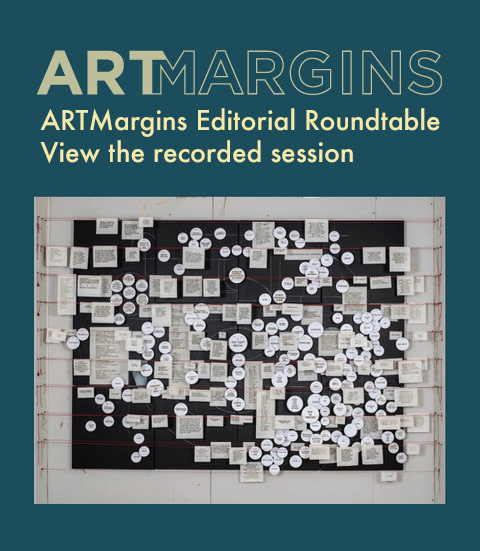
I generate diagrams with the purpose of understanding the narratives, form, and aesthetics of sociocultural and political structures. This leaves room for the production of artistic works that can be introduced into the machinery of everyday life. The idea of the diagram emerged almost at the same time as the idea of the machine, although we cannot really tell which existed first. However, it seems clear that both are intrinsically connected. Machines and diagrams can be seen as a representation of a narrative system that leads the process of the creation of knowledge. What they share is essentially narrative: we … Read more
This article analyzes the rhetorical and discursive resonance of the claims by artists and art professionals in Brazil in the 1950s of a connection to the Bauhaus. I examine the curricula of two new art schools established in São Paulo and Rio de Janeiro, emphasizing the role of central figures, including Mário Pedrosa, and the works by artists trained at the schools, and study paintings by Lygia Clark that in part elicited Alfred H. Barr, Jr. in 1957 to dismiss Brazilian contemporary art as “Bauhaus exercises.” Rather than a case of imitation, as Barr suggested, Brazilian actors transformed Bauhaus ideas, … Read more
The introductory text foregrounds the article “From the Stamps to the Bubble” (1968) by Brazilian historian and curator Aracy A. Amaral. It seeks to locate the primary document within a broader historiography of Brazilian art in the second half of the 1960s, and examine the ways in which the military dictatorship, along with certain cultural exchanges facilitated by Brazil’s economic development in this period affected artistic production. Placing particular attention on the multiple terminologies that were in use when the article was written, the introduction focuses on the contiguities of Pop Art in the Brazilian cultural milieu. It argues that … Read more
The introductory text foregrounds the article “From the Stamps to the Bubble” (1968) by Brazilian historian and curator Aracy A. Amaral. It seeks to locate the primary document within a broader historiography of Brazilian art in the second half of the 1960s, and examine the ways in which the military dictatorship, along with certain cultural exchanges facilitated by Brazil’s economic development in this period affected artistic production. Placing particular attention on the multiple terminologies that were in use when the article was written, the introduction focuses on the contiguities of Pop Art in the Brazilian cultural milieu. It argues that … Read more
Reacting against politically monopolizing attempts at rewriting the socialist past in post-1989 Hungary and Romania, a diverse number of artists, curators, critics, activists and students have come together to form temporary organizations and institutions. Through a contextual reading and critical analysis of The Department for Art in Public Space (2009–2011) in Bucharest and DINAMO (2003–2006) and IMPEX (2006–2009) in Budapest, this article investigates what the author refers to as a “self-institutionalizing” and the ways in which this practice becomes a vehicle to rear politicized civil societies in post-cold war Central and Eastern Europe. The discussion of the two self-institutionalizing initiatives … Read more
By placing on view a large selection of objects recently acquired by the New York Museum of Modern Art, the exhibition Incident Transgressions: Report on “Transmissions: Art in Eastern Europe and Latin America 1960–1980” (September 5, 2015 to January 3, 2016) sought to situate artistic practices from Latin America and Eastern Europe within a discursive model of cross-cultural and aesthetic transmission. However, the exhibition marginalized an account of the specific relations between these objects in favor of a more encompassing global curatorial narrative. While seeking to outline the parameters of the exhibition, and its implications in regard to contemporary trends … Read more
This text examines the first official exhibition of the Yugoslav Association of Fine Artists, and the theoretical, socio-political, and institutional contexts of the Socialist Realist period in Yugoslav art (spanning roughly the years between1945 and 1954). Post-war artistic and cultural environment, the first exhibition, and critical aesthetic debates around Socialist Realism exemplify Yugoslavia’s struggle to make sense of, and implement, Socialist Realism as an official artistic, cultural, and political category. Its development paralleled the state’s own wrestling with notions of socialist governance and its proper implementation. Difficulties with Socialist Realist aesthetic and the ensuing paradoxes in its adaptation in Yugoslav … Read more
Follow:
Search ARTMargins
NEW: ARTMargins Print 15:2
This issue of ARTMargins presents texts that navigate past and present confrontations with instances of entrenched political power. In some cases, these navigations reflect the authors’ critical analysis of their own experiences and positionality, a necessary step in shaping modes of resistance. In other cases, the complex functions of past, and supposedly monolithic, regimes—be they colonial or state socialist—are recovered through careful attention to the exercise of artistic agency within them.
ARTMargins has two outlets, ARTMargins Print and ARTMargins Online, each with their own distinct content. You can find out more about both outlets on this page. To purchase copies of ARTMargins Print issues, or to subscribe, go to the MIT Press page.
We use cookies to ensure that we give you the best experience on our website. If you continue to use this site we will assume that you are happy with it.