Interview with Luchezar Boyadjiev: Imaginary Monuments and the Public Sphere
Throughout his prolific career, artist Luchezar Boyadjiev has addressed the power dynamics of systems of belief, whether political, religious, or artistic. Long inspired by the public works of Christo and Jeanne-Claude, Boyadjiev explores the social conditions of public space and the urban environment through speculative projects – in the form of photographs, digital collages, temporary installations, performances, and public dialogues – that question traditional symbols of power and serve as counter-monuments to canonical history. On the occasion of the many anniversaries happening this year celebrating some of Christo and Jeanne-Claude’s most iconic projects (The Gates, New York City; Wrapped Reichstag, Berlin; The Pont Neuf Wrapped, Paris), I spoke with Boyadjiev about his recent project, Christo and Jeanne-Claude for Beginners, which envisions imaginary monuments to both artists, as well as other works that reshape the landscape of commemoration and remembrance.
Susan Snodgrass: Your interest in the lives and work of the artists Christo and Jeanne-Claude has been long-standing, from your early writings as a critic and art historian to your recent artistic project Christo and Jeanne-Claude for Beginners. When did you first meet the artists?
Luchezar Boyadjiev: My interest in (you might call it an infatuation with) the work of Christo and Jeanne-Claude dates back to the late 1970s and early 1980s. I met them by chance in Soho in New York City in May 1981. Whatever words were exchanged then, whatever impressions were made, the fact is they remembered me for no obvious reason. On the day of our meeting, they sent me a Christo-signed poster of Running Fence (1972-1976), a project very closely associated with Bulgaria and the Eastern Bloc. Christo claimed that he was inspired by the Orient Express still running across Bulgaria in the 1950s and the summer brigades that he was a part of as an art student at the National Art Academy in Sofia. The students then were helping the cooperative farms located along the tracks of the Orient Express west of Sofia near the Serbian border. They did beautifying jobs much like the so-called Potemkin villages in 18th-century Imperial Russia. That made the artist realize the potential of space, of investing symbolic forms in the landscape, of working with simple farmers and their land. Of course, later on, Christo and Jeanne-Claude realized Wrapped Reichstag, Project for Berlin (1971-1995), which is even more closely linked to Bulgaria and Eastern Europe: after the Nazis came to power in Germany in the mid-1930s, there was a massive fire in the Reichstag for which three Bulgarian communists were blamed and put on trial in Leipzig – a trial that became a unifying call for all the progressive anti-fascist forces at the time.
My project Christo and Jeanne-Claude for Beginners, at Sarieva/Gallery in Plovdiv in 2022, had several public manifestations, with its central question being, What should be done with the legacies of Christo and Jeanne-Claude now that they are gone? The project lasted for a few months and included: a solo show of my own work; the group exhibition Power Girls in Public Space: Jeanne-Claude for Beginners; public walks across town in search of a possible location for this impossible monument to Christo; and a night event in the center of Plovdiv where the shadow of a model for a proposed monument was projected. At the end of the project, we had a public debate at the Cultural Center at Sofia University.
Christo and Jeanne-Claude and their work are such an important part of my life and art that it would be an understatement to talk just about the project in Plovdiv. They are important to me because of the many visionary examples they offered: how to dream, how to project and visualize ideas, how to engage with multiple audiences and circumstances, how to envision and interact with public space. Apart from the support they so generously gave me, their legacy is always in the back of my mind, perhaps as a point of orientation. It would be quite presumptuous to think that there might be any artist(s) working on such a scale of beauty and impact, but I’ll never stop dreaming.
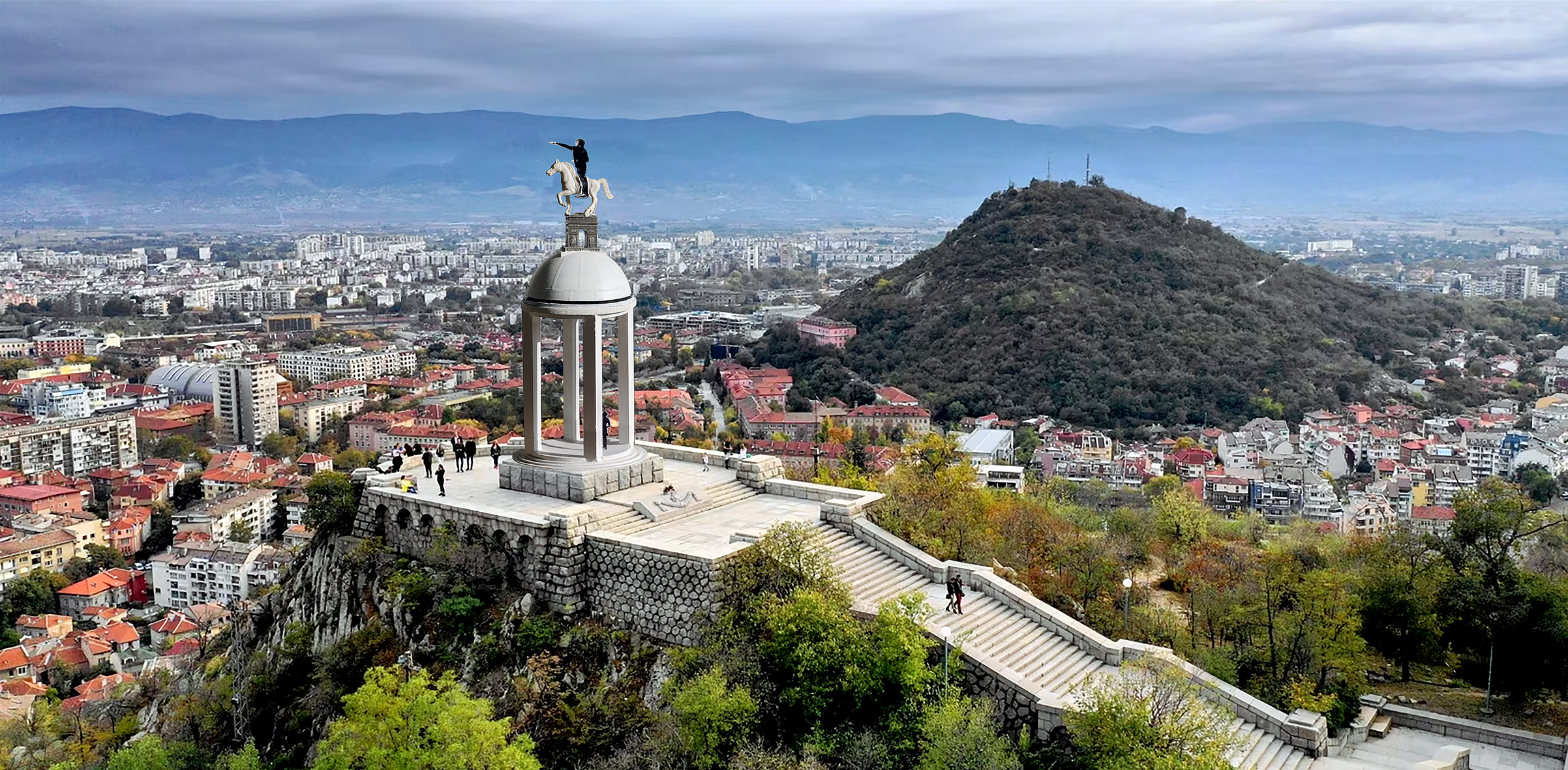
Proposed location for a monument to Christo in Plovdiv, 2022. Digital rendering, print. Courtesy the artist and Sarieva/Gallery.
SS: Christo for Beginners, the first part of this multi-tiered project, was an “exploratory mandate” to envision a colossal equestrian monument to this Bulgarian-born artist activated through a series of public talks, walks, and exhibitions. The show of your work included a scale model of the proposed monument with a photographic image of Christo atop a horse atop a triumphal arch atop a domed tholos, essentially employing many of the classical tropes associated with monuments. How did your project challenge the power structures embedded within these historical forms? What new kinds of commemorative symbols and practices does the project advocate?
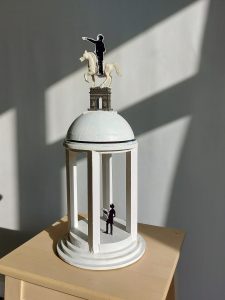
Project for an equestrian monument to Christo, Plovdiv, 2022. Mixed-media sculpture, scale-model. Courtesy the artist and Sarieva/Gallery.
LB: I was challenging notions of what a monument might look like today, where and for whom, and most importantly, why a legacy such as Christo and Jeanne-Claude’s might even make sense conceptually as a context to think of a monument. In the project for a monument to Christo, I used a photograph of the artist from his first large-scale public work –Wrapped Coast, One Million Square Feet, Little Bay, Sydney, Australia (1968-69). It’s an image of a young Christo, not much older than the age I was when I met him in New York. But most important is the artist’s stance, pose, and gesture – he looks like a leader of the masses, generating responses, and activating/instructing his crew (and the public by association) into realizing a beautiful, yet utopian vision that until then the artist alone saw as worthy, doable, and possible. So, the cutout sillhoutte of the gesturing Christo on top of a horse is a visual statement when incorporated into a model for a monument – it’s honoring Christo’s massive vision. It also looks like the gesturing Lenin as he was depicted in the first public monuments in Russia from the 1920s, for instance the one in Nizhny Tagil, the city beyond the Ural Mountains. The half globe on top of which I positioned a small souvenir of the Arc de Triomphe and the silhouette of Christo on horseback is rotating.
In 2024, I created a proposal for an equestrian monument to Jeanne-Claude in Gabrovo, the city where Christo was born. I consider her the most world-renown “daughter-in-law” of Gabrovo, a power girl with huge efficiency in public space – art, media, finance – and a powerful, charismatic presence. As a result, I realized her as an action figure on top of two horses on top of a rotating half globe. That project was a continuation of one part of the Plovdiv project from 2022– the group show Power Girls in Public Space: Jeanne-Claude for Beginners (note 2) with fourteen international female artist-friends, whom I consider to be somehow linked to the attitudes Jeanne-Claude displayed in her work and presence.
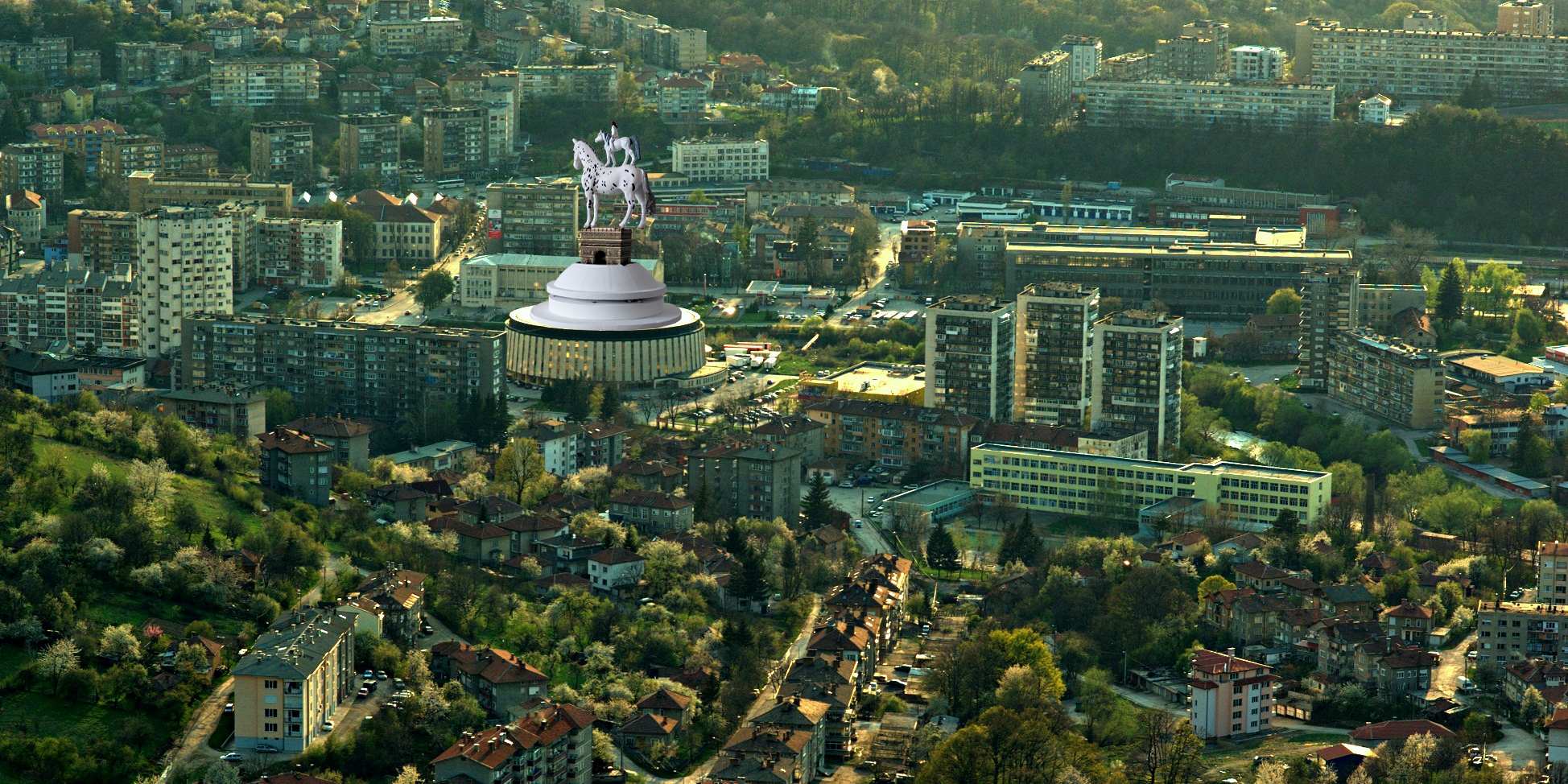
Monument to Jeanne-Claude in Gabrovo, 2023-24. Digital rendering, print. Courtesy the artist and Sarieva/Gallery.
SS: In what ways did the works in Power Girls in Public Space offer alternative views for how women occupy the public spaces of the city? How did the exhibition broaden one’s understanding of Jeanne-Claude and her contributions to public art?
LB: Suffice it to say that this part of my project in Plovdiv attempted to make more visible to the public the statements and platforms of the young generation of female artists. Not only artists who question patriarchal norms but, like Jeanne-Claude, do not waste too much time on public discourse or activism, but rather just create art and take a stand, those who disregard unimportant labeling and time-consuming distractions and work in spite of all and any manifestations of patriarchal society!
I have written elsewhere about the importance of Jeanne-Claude’s contribution to the whole oeuvre of public art. Most notably and with the help of their lawyers, she invented a corporate structure, the CVJ Corporation, in the United States, which transformed (as if by a legislative miracle) the works of art produced by Christo – ideas, drawings, models, prints –into objects of dual status, artworks as well as financial instruments. People didn’t acquire shares in CVJ; rather, they acquired shares in their projects, in the form of the artist’s beautiful drawings. Thus a drawing by Christo was also a financial instrument that translated the symbolic value and talent of the artist into tools of finance. With the high level of liquidity of Christo’s artworks, investors (actually art collectors) were only too happy to invest in the projects of the corporation. CVJ was established in 1982 to facilitate the realization of Surrounded Islands (1980-1983). It was covered by the Wall Street Journal in 1984, and its operations were documented in a special report initiated by Harvard University’s business school, which covers the path to funding The Gates (2005) in New York City.
SS: From my understanding, the goal of Christo and Jeanne-Claude for Beginners was to initiate new conversations around memory politics, public space, and monumentality. Or will there, indeed, be real monuments to Christo and Jeanne-Claude created?
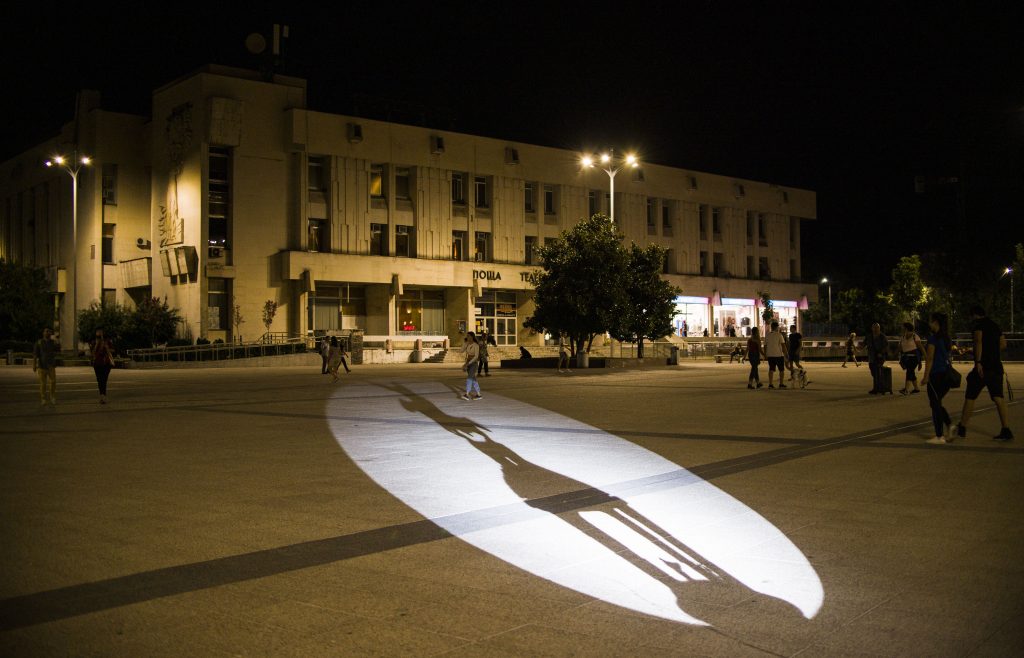
The Presence of Absence. Phase 2, Christo for Beginners. Specially rendered slide-projection of the shadow of a proposed monument to Christo transported across central Plovdiv. September 2022. Courtesy the artist and Sarieva/Gallery.
LB: God forbid there would be a monument to either Christo or Jeanne-Claude in any form, place, or size! That was the point of the project, especially here in Bulgaria, as the art of Christo and Jeanne-Claude is totally antithetical to monuments. I was dealing with their notion of “presence of absence.” That’s why I only created collages, drawings, scale models, and for the Plovdiv show, an intentsive PR campaign and action in the city center. The project also relates to some folkloric beliefs in Bulgaria, or the Balkans (I have no idea if other people have the same belief), which claim that in order for a new building to have strength and endurance the shadow of a living person should be integrated in the foundation. Well, actually according to lore, it should be the body of somebody, a young woman preferably, but I will never consider this as an option no matter how tempting for securing the lasting legacy of my art idols.
The goal was to start a conversation. The PR company we employed did a great job in promoting the project and also collecting public reactions in both mainstream and social media. The bottom line is that about 70 % of the reactions did get the crucial point – the work of Christo and Jeanne-Claude is totally against monuments, even though their projects are massive in scale and leave a massive trace in the consciousness of the public. That raises the question: Do we need monuments at all? If yes, whose life merits a monument? Other reactions ranged from the critique of the proposed monument’s style and artistic merits of my project (total shit, they thought), to the hate-infected opinion based on the fact the Christo never returned to Bulgaria (which might not be entirely the case) and, worst of all, that he never spoke Bulgarian in public.
Regarding the latter, I have some personal knowledge. Christo had dyslexia, he spoke broken English, French, and also Bulgarian. Once in 1993, I visited Christo and Jeanne-Claude in their studio in New York while on a Getty Grant. I asked him about why he never spoke Bulgarian in public. The answer was pure modesty and humility. In his words, speaking in broken Bulgarian in public, whether in Sofia or elsewhere, would have been perceived as something even worse. However, if one pays close attention to the videos of his late public lectures, one would be shocked at how many Bulgarian words he is actually using, without even realizing it. So, I think as far as Bulgaria was concerned, Christo would have been blamed for being ignorant of the homeland (which actually disowned him), and disrespectful of the language of his family and early beginning.
SS: Your continued interest in monuments extends to other projects including your exhibition Public Space / Private Size at Structura Gallery in Sofia in 2023. In this series of small-scale models for proposed monuments to real and fictional characters, the human figures are replaced by allegorical animal forms. Can you discuss your ideas regarding “interspecies justice” and how this body of work addresses systems of power within the public environment?
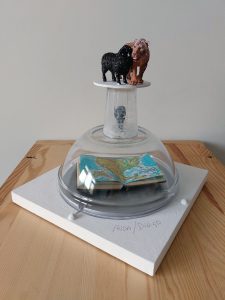
Project for a monument to Frida Kahlo and Diego Rivera, from exhibition, Public Space / Private Size at Structura Gallery in Sofia, 2023. Mixed-media sculpture, scale-model. Courtesy the artist and Sarieva/Gallery.
LB: I am still in the middle of this project. I have the intuition that public space should be made more humanly accessible and friendly. I hate phallocentric arrangements of urban environments, such as the many equestrian monuments to all sorts of male characters in key points of city maps. Apart from that, the infusion of private references into public space is long overdue.
But to the point, an animal figure in public space looks to me just as human as a human figure in a zoo, a colonial practice we tend to forget about although it is still in the minds of many. Bulgaria did not take part in the Eurocentric project of colonization simply because the country ceased to exist after 1395 or so, a good 100 years before Columbus was found lost at sea. Today, we do have the duty to “share” the negatives of that Eurocentric history on account of being a member state of the European Union, which is good in general but really hard if you are an artist.
The series honors not only artists but also people like Mother Teresa, Jane Fonda, Tom Waddell (a dear friend from the early 1980s), and others. The idea is to use household objects – vases, kitchen tools, toys –as the bases for models of monuments that contain no human figures but figures of animals that I see as related to the person to whom I dedicate a monument. So objects for private use are incorporated into models for monuments to public figures meant for public space. The series is growing and now numbers more than thirty works.
SS: Your Utopian Solutions for Dystopian Cities, an ongoing series of drawings and speculative digital visualizations that address the ecological challenges facing cities, also remaps the urban environment. But rather than proposing monuments or new sites of history, you create hypothetical solutions for solving climate issues on a monumental scale. Can you talk more about this series. Will any of these projects be realized?
LB: This series started with an observation I made in June 2007 after four major art events took place one after the other – the Venice Biennale, documenta, the Sculpture Project in Münster, and the Basel Art Fair. Overwhelmed by the amount of travel that this kind of “Grand Slam” implies, I spent a month calculating my own carbon footprint left by travelling for professional reasons between the end of 1990 and the end of 2007. I then started thinking of what I could do, even if only as a utopian gesture, for the cities that we in the visual arts exploit for our own professional satisfaction.
These projects are utopian indeed, but as realizable as Leonardo da Vinci’s ideas would have been during his life time! All of the drawings is this series, fifteen and counting, are executed in the precisely same format: they all measure 107 x 207 cms, are made by translating digital images and montages into paper and pencil drawings, and always identified by a short-liner title that encapsulates the main proposal for each city. Given the dire impact of climate change, the proposed ideas must be realizable; if not now, then in the near future. They have to be simple and visually clear, and are urgently needed for the benefit of the cities with which I engage.
For instance, Venice needs an underground subway system, a spiral shaped configuration of tubes dotted with pillars placed on the bottom of the lagoon meant to support the islands while diverting the accumulation of sediments in the water. Paris needs two more Eiffel Towers, not only to create a fresh look for the city but also to provide a democratic way of dealing with tourists – if you build two additional towers, erected at the height of level one and level two of the original but a bit to the side, then everyone who climbs to the top will gain a special sense of self-esteem. The Old Town of Jerusalem needs to hover like a hologram – separating sacred lives from the profane. Singapore needs to clone itself and save London while doing so – a kind of reverse colonization of a successful social model. For Istanbul, I have an idea to enhance the already existing project to dig an alternative waterway doubling The Bosporus Strait – on the European side, about 30km from downtown. I thought that since the city is such a universe on its own, it might need to separate from both Europe and Asia by building not one, but two circular channels, one on each side of the city in each continent
SS: With Utopian Solutions for Dystopian Cities, I see some similarities between your use of visionary drawings, maps, and collage and Christo’s two-dimensional project renderings. Is this intentional?
LB: Your are totally right! This is my tribute to Christo. There are few artists I think of as a my root source of creativity and Christo is one of them—not only his ideas, but how he presents his projects. For the visual basis of his glorious drawings, the artist used photographs by Wolfgang Volz made to Christo’s exact specifications. Volz’s images have clearly defined viewpoints, distances, perspectives, saturation of urban detail, and proportions. Christo used these as if he was planning an architectural redesign of the concrete space and environment, enlarging the photographs with a grid in order to realisticly render his drawings by hand.
I use Goole Maps, earth and street views in order to build a convincing, though heavily deformed visualization of my own point of view – needed in order to have the best possible vantage point for the suggested solution. The main part is to be visually convincing, to realize the drawing with the tools learned within the conservative traditions of art education and classical drawing at the Sofia Art Academy. I use digital images and projections in order to not think about anything else but the rhythm of mark making. I also use collage elements if that suits me. From a distance, my drawings create the impression of city views and maps, but up close, they look like a random, even chaotic mesh of twisting hand-drawn lines and quirks.
SS: Can you discuss your work around monuments and counter-monuments within the broader context of global movements to remove, for example, U.S. Confederate statues, or socialist monuments throughout Eastern Europe and the Balkans, including Bulgaria?
LB: I think removing monuments is a false movement. Better to present the public with alternative views and narratives of historical events. Who knows? There are no easy answers. History has a lot of examples of how to deal with the politics of the day in regards to the rudiments of the past, for example, the two different Vietnam War memorials in Washington, DC. We need to find a way to respect differences, preferably simultaneous and parallel differences, but as we know “history is written by the victors.” There are of course monuments that are intolerable, but how do we change what has happened without hiding behind new versions of the past?
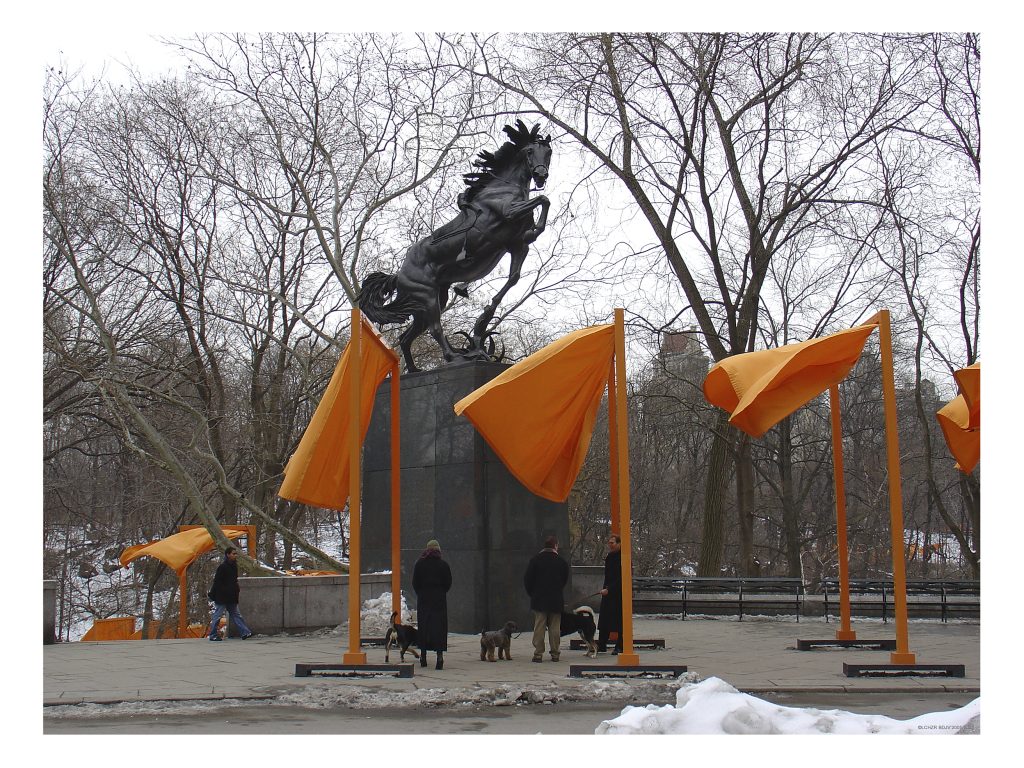
On Vacation: Jose Marti from New York City, 2005-2025. Digitally manipulated photograph, print. Courtesy the artist and Sarieva/Gallery.
My answer is the series On Vacation, in progress since 2004, to which I am fully committed right now. It is a cycle of digitally manipulated images where I remove the human figure from photographs of equestrian monuments, thus sending politically charged historical figures “on vacation” and maybe liberating various public spaces for a short (digital) while. This is a procedure deeply rooted in my entire practice. I see it as a continuation of the practices of Berlin DADA, for instance John Heartfield, who employed montage and de-montage via the photographic image to offer alternative views of reality.
It is also important to me that this simple gesture could be performed on any photograph of any monument in the world; I do not have to travel anymore as there are so many options to source photographs online. Initially, I would take photos of equestrian statues in public spaces when traveling to various cities Then I would remove the human figures in Photoshop. It is a tedious and time-consuming process, but it is rewarding. I am committed to a solo exhibition, Corpus Equidae: On Vacation 2004-2024, at the Kvadrat 500 venue of the National Gallery in Sofia of whatever number of images of de-monumented horses I can manage by the beginning of July 2025, when the show opens. [The show runs to October 2025.] My aim is to have 500 sample prints from the series on view. While using online resources to collect images, I can say that there are approximately 1,700 examples of equestrian monuments all over the world, in all kinds of places, including in some nice villages I pass by while driving across Bulgaria to my country home in the middle of the Balkan Mountains.
Everyone likes to have a statue of a horse, but in most cases, the figures on top are problematic. So, I encounter many examples of monuments being cast and recast, relocated and dismantled, renamed and recontextualized. All I know is that horses are never guilty of anything. In fact, they are the ones who need a vacation from us humans.
This conversation took place via email in March and April 2025, and has been edited for length and clarity.
Christo for Beginners took place at Sarieva / Gallery, Plovdiv, Bulgaria, August 5-September 30, 2022. Power Girls in Public Space: Jeanne-Claude for Beginners, also at Sareiva / Gallery, was on view September 9-October 9, 2022. Public Space / Private Size was on view at Structura Gallery, Sofia, June 22-July 25, 2023. The project Utopian Solutions for Dystopian Cities was shown in the exhibition Urban Daydreaming at the Institute of Contemporary Art-Sofia, April 27-June 3, 2023.
Luchezar Boyadjiev
 Luchezar Boyadjiev (1957) was born in Sofia, Bulgaria, where he lives and works. He began his artistic career after the fall of the Berlin Wall in 1989. His work engages with personal interpretations of social processes, the interaction between private and public, urban visuality and today's world split between utopia and anti-utopia. His recent solo exhibitions include: Luchezar Boyadjiev: Sic transit media mundi /The Present is Too Short and Rather Tight, the City Art Gallery, Sofia, for which he was awarded the 2018 Sofia Municipality Award for outstanding achievement in visual art;Luchezar Boyadjiev: Re-building the World of Images: 1991-2019, MOMus Contemporary, Thessaloniki, Greece (2020);Urban Daydreaming, ICA-Gallery, and Public Scale, Private Size, Structura Gallery (both Sofia, 2023). He alsoparticipated in Manifesta 14, Prishtina, Kosovo (2022), and the 4th Autostrada Biennial, Prizren, Kosovo (2023). His one-person exhibition, Corpus Equidae: On Vacation, 2004-2024, will open at Kvadrat 500, the National Gallery, Sofia, later this year. He s represented by Sarieva/Gallery, Plovdiv, Sofia.